


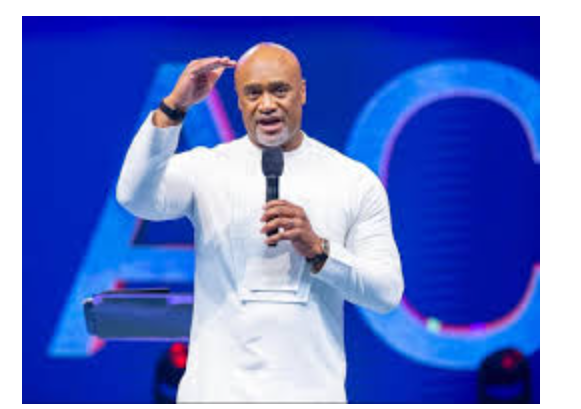
Pastor Adefarasin Sparks Debate, Claims Nigeria’s Nationalist Icons Are Not True Founding Fathers.
Senior Pastor of House on the Rock Church, Paul Adefarasin, has ignited widespread controversy with a bold assertion that Nigeria’s celebrated nationalist leaders—Obafemi Awolowo, Nnamdi Azikiwe, Ahmadu Bello, and Tafawa Balewa—cannot be considered the country’s true founding fathers. Delivering a sermon in Lagos on Sunday, 24 August 2025, the cleric argued that Nigeria’s formation was orchestrated by British colonial powers for economic gain, rather than by the vision of its revered independence leaders.
Adefarasin challenged the notion that Nigeria’s existence was divinely ordained, attributing its creation to colonial machinations in Whitehall boardrooms and the influence of figures like Lord Frederick Lugard. “Awolowo, Tafawa Balewa, Ahmadu Bello, and Azikiwe are not the founding fathers of Nigeria in my opinion,” he declared, suggesting that the nation was shaped to serve Britain’s financial interests. He claimed Nigeria was “created for the business of the British purse,” referencing historical deals involving Queen Elizabeth I and the Ottoman Empire, as outlined in the book *The Martyrdom of Man*, which he urged his congregation to read for further insight.

The pastor’s remarks extended to Nigeria’s constitutional framework, which he described as illegitimate because it was drafted by military authorities rather than “we the people.” Quoting Psalm 11:3, he likened Nigeria to a building on a flawed foundation, arguing that no nation can thrive when rooted in injustice. “When a constitution is not of the people, you have to question why we obey it,” Adefarasin said, criticising systemic issues such as poorly constructed roads, which he suggested are intentionally substandard to secure repeat contracts, reflecting a lack of equity in governance.
The sermon, which quickly gained traction on social media, sparked polarized reactions. On platforms like X, some Nigerians agreed with Adefarasin’s perspective, with users like @UndefeatedEmma2 stating, “He is right. How can you join people of different cultural beliefs and history together just to achieve your selfish aim of ruling them forever?” Others, such as @BrotherAghama, remarked, “It doesn’t take rocket science to know Nigeria was a creation of the British empire.” However, critics argued that dismissing the contributions of Awolowo, Azikiwe, Bello, and Balewa—key figures in Nigeria’s independence struggle—undermines their legacy and the sacrifices made to end colonial rule.
Adefarasin’s comments come amid heightened national discourse about Nigeria’s identity and governance, with many questioning the country’s colonial legacy as the 2027 elections approach. Political analyst Dr. Chidi Okonkwo noted that while the pastor’s views highlight the colonial origins of Nigeria’s amalgamation in 1914, they risk oversimplifying the roles of nationalist leaders who fought for self-governance. “Awolowo, Azikiwe, Bello, and Balewa shaped Nigeria’s early political landscape and laid the groundwork for independence, even if the initial framework was colonial,” Okonkwo said.
The cleric’s sermon also touched on broader issues of governance, accusing the system of perpetuating corruption and inequity. He cited substandard infrastructure projects as evidence of deliberate mismanagement, a sentiment that resonated with some congregants who see Nigeria’s challenges as rooted in its colonial past and post-independence governance failures.
This is not the first time Adefarasin has courted controversy. In June 2025, he faced allegations of brandishing a firearm at a popular TikTok content creator, an incident that further amplified his public profile. His latest remarks have added fuel to ongoing debates about Nigeria’s historical narrative and the path to national reform, with many calling for a re-examination of the country’s foundational structures as it navigates economic and political challenges.
As Nigeria approaches its next electoral cycle, Adefarasin’s provocative statements are likely to keep the spotlight on the nation’s colonial legacy and the quest for a more equitable constitutional framework, prompting both reflection and division among citizens.
