


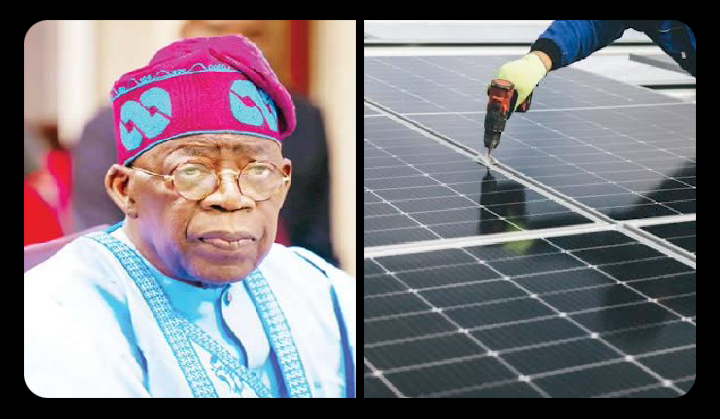
Outrage As Tinubu Government Defends N10bn Solar Power Project For Presidential Villa.
The Human Rights Writers Association of Nigeria (HURIWA) has sharply criticised President Bola Tinubu’s administration over the Federal Executive Council’s (FEC) approval of a ₦10 billion solar power project for the Presidential Villa, describing the initiative as a damning indictment of Nigeria’s failing electricity sector.
The announcement has ignited widespread debate, with HURIWA accusing the government of mismanaging priorities and admitting, albeit indirectly, to the chronic dysfunction within the national grid. Emmanuel Onwubiko, HURIWA’s National Coordinator, argued that shifting the Villa to solar energy underscores the “gross incompetence” of the Minister of Power and highlights the unaffordable and unreliable electricity being delivered by the Transmission Company of Nigeria (TCN) and the Distribution Companies (DisCos).

“The decision to spend ₦10 billion on a solar upgrade at a time when millions of Nigerians live in darkness is not only selfish but a stark admission that the national electricity grid is a failure,” Onwubiko stated. He further accused the government of indirectly acknowledging that the current electricity tariff structure is exploitative and unsustainable.
The Presidency, however, stood firm in defence of the initiative. Special Adviser to the President on Information and Strategy, Bayo Onanuga, cited international examples in a bid to justify the project’s cost and timing. Sharing a video of solar panels at the White House in Washington, D.C., Onanuga noted: “The White House uses solar power. Nigeria is aligning with global best practices in sustainability.”
While the administration insists the project aligns with broader energy reform and environmental goals, HURIWA dismissed such comparisons as tone-deaf in the face of Nigeria’s pressing infrastructural and economic challenges. The rights group criticised the move as elitist and detached from the daily realities of ordinary Nigerians, millions of whom still lack consistent access to electricity.
Adding fuel to the fire, HURIWA likened the controversial Band tariff system imposed by DisCos to a scam, comparing it to infamous internet frauds such as those perpetrated by Ramon “Hushpuppi” Abbas. “This is not merely poor governance — it’s a betrayal,” Onwubiko added.
Despite the backlash, the Presidency maintains that the solar system — which aims to provide stable electricity for the President’s residence, administrative blocks, and other critical buildings within the State House — will improve energy efficiency and deliver cost savings over time.
Public opinion remains divided. Some Nigerians have welcomed the move for its potential environmental benefits and its alignment with renewable energy trends. However, many continue to question the timing and cost of the project, especially amid rising inflation, subsidy cuts, and growing hardship across the country.
As the debate rages on, one thing is clear: while the Presidential Villa may soon enjoy uninterrupted clean energy, much of Nigeria continues to wait in the dark — both literally and figuratively.
