


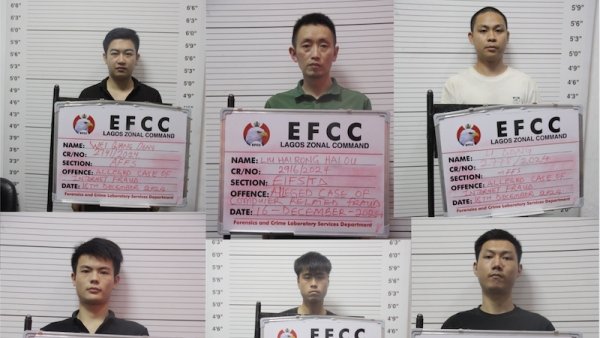
Lagos Court Sentences Nine Chinese Nationals To One Year In Prison For Cyber-Terrorism And Internet Fraud.
The Federal High Court in Ikoyi, Lagos, has convicted and sentenced nine Chinese nationals to one year in prison each for their involvement in cyber-terrorism and internet fraud, marking a significant step in Nigeria’s fight against transnational cybercrime. The convicts, identified as Li Dong, Deng Wei Qiang, Huang Bo, Xiong Zhen, Lai Rui Feng, Zhao Xiao Hui, Liu Hai Rong, Liu Gang, and Du Ji Feng, were also fined £480 (N1 million) each, with their sentences effective from their arrest on 10 December 2024.
The group was part of a massive 792-member syndicate apprehended during the Economic and Financial Crimes Commission’s (EFCC) “Eagle Flush Operation” on 10 December 2024, at a six-storey building on Oyin Jolayemi Street, Victoria Island, Lagos. The EFCC described the raid as its largest single-day cybercrime crackdown, targeting a sophisticated network accused of cryptocurrency investment scams and romance fraud. The operation resulted in the arrest of 599 Nigerians and 193 foreign nationals, predominantly Chinese, suspected of orchestrating schemes to destabilise Nigeria’s economic and social fabric.

According to the EFCC, the convicts wilfully accessed computer systems to perpetrate financial terrorism, recruiting Nigerian youths to engage in identity theft and impersonate foreign nationals for financial gain. The charges, brought under Section 18 of the Cybercrimes (Prohibition, Prevention, etc.) Act 2015 (as amended in 2024) and Section 2(3)(d) of the Terrorism (Prevention and Prohibition) Act 2022, accused the defendants of conspiring to destabilise Nigeria’s economy through fraudulent activities. One charge read: “That you, Li Dong, Deng Wei Qiang, Huang Bo, Xiong Zhen, Lai Rui Feng, Zhao Xiao Hui, Liu Hai Rong, Liu Gang, and Du Ji Feng, sometime in December 2024 at Lagos, within the jurisdiction of this Honourable Court, conspired amongst yourselves to commit an offence to wit: cause to be accessed computer system used for the purpose of destabilising and destroying the economy and social structure of Nigeria.”
Initially pleading “not guilty” when arraigned in February 2025, the nine defendants changed their pleas to “guilty” on 5 June 2025, following a plea bargain agreement with the EFCC. During Thursday’s proceedings, EFCC counsel Nnaemeka Omewa confirmed the plea deal, supported by defence counsel Folarin Damela, who urged the court to accept it. Justice Daniel Osiagor, presiding over the case, convicted the defendants and imposed the agreed sentence, ordering their deportation to China upon completion of their prison terms. Additionally, all items seized during the raid, including laptops, computers, and furniture, were forfeited to the Federal Government of Nigeria.
The EFCC highlighted the syndicate’s use of advanced technology and social engineering to defraud individuals and institutions globally, with digital trails traced to Europe, North America, and Southeast Asia. Chinese Ambassador Yu Dunhai expressed regret over the involvement of Chinese citizens, proposing a joint working group with Nigerian authorities to combat cybercrime, though the EFCC remains focused on further prosecutions.
The ruling sends a clear message: Nigeria is intensifying its crackdown on cybercrime, and perpetrators, regardless of nationality, will face justice. The EFCC encourages the public to report suspicious activities and verify investment platforms with the Securities and Exchange Commission (SEC) to avoid falling victim to similar scams.
