


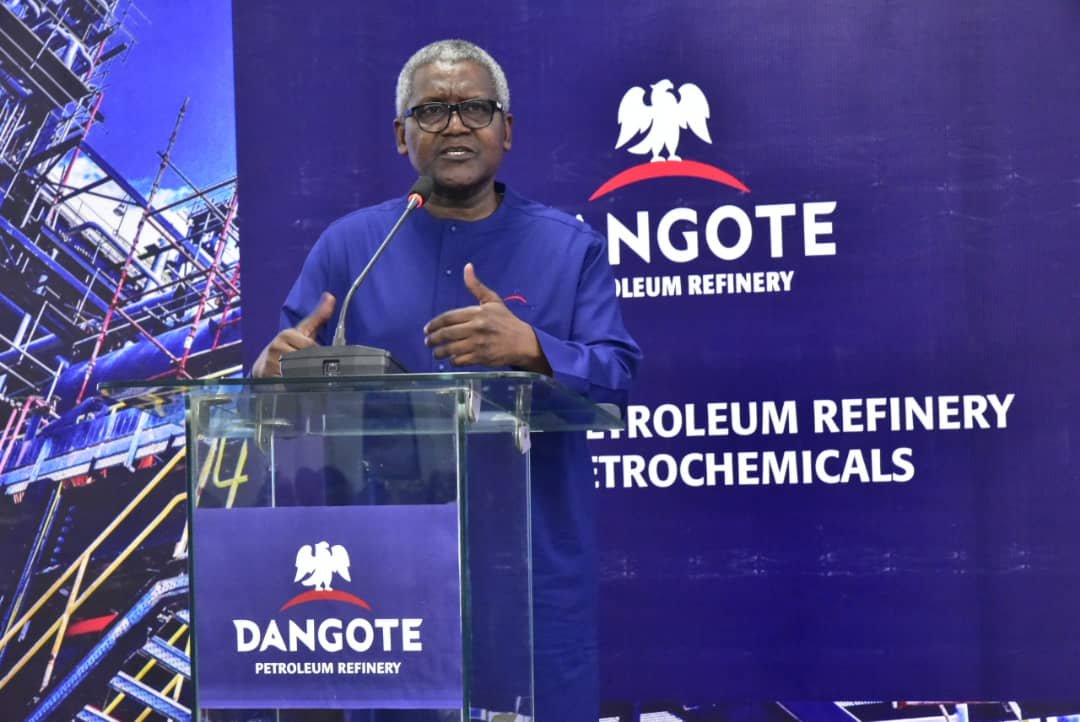
Dangote Pushes For Ban On Refined Petroleum Imports To Bolster Nigeria’s Economy.
Alhaji Aliko Dangote, President of the Dangote Group, has called on President Bola Tinubu to extend the Federal Government’s ‘Nigeria First’ policy to include a ban on importing refined petroleum products. The appeal, made at the Global Commodity Insights Conference on West African Refined Fuel Markets in Abuja, has sparked a heated debate among industry stakeholders, with some praising the move as a boost for local industry, while others warn of potential risks to competition.
Dangote, whose $20 billion refinery in Lekki is Africa’s largest, argued that continued importation of petrol, diesel, and other refined products undermines local refineries and deters investment in Nigeria’s energy sector. He highlighted the success of his refinery, noting that Nigeria has become a net exporter of petroleum products, with approximately 1.35 billion litres of petrol exported globally between June and July 2025. “Today, Nigeria is a net exporter of refined products. In just 50 days, we’ve exported about one million tonnes of petrol,” Dangote stated, underscoring the refinery’s capacity to meet domestic demand and support exports.

The ‘Nigeria First’ policy, introduced in May 2024, prohibits government agencies from importing goods or services available locally without a valid justification and a waiver from the Bureau of Public Procurement. Dangote urged that this policy be applied to the petroleum sector to protect local refiners from what he described as “unfair competition” caused by the influx of cheaper, often substandard, imported fuels. He claimed that some imported fuels, including toxic blends banned in Europe, are being dumped in Nigeria, undercutting local production and compromising safety standards.
However, the proposal has met with strong opposition from oil marketers and industry experts. Chinedu Ukadike, National Publicity Secretary of the Independent Petroleum Marketers Association of Nigeria, argued that banning imports could harm the sector, stating, “Importation won’t kill local refineries; it will strengthen them by ensuring they step up their game.” Similarly, Billy Gillis-Harry, National President of the Petroleum Products Retail Outlet Owners Association of Nigeria, cautioned against allowing a single company to dominate the downstream sector, emphasising the need for multiple energy sources in a free economy.
Dangote also pointed to broader challenges facing African refineries, including the offshore Lomé floating market in Togo, where international traders store over two million tonnes of petroleum products for sale at inflated prices. He alleged that these traders, along with corrupt political actors, actively work to stifle local refining efforts across the continent. “When you build a refinery, you’re not just innovating—you’re challenging powerful interests that will fight back,” he said.
Despite the controversy, Dangote’s refinery has already transformed Nigeria’s energy landscape. With a capacity to process 650,000 barrels of crude oil daily, the facility is designed to meet 100% of Nigeria’s refined product needs while generating surplus for export. The refinery’s operations have also created thousands of jobs, with the potential for 135,000 permanent positions when fully operational.
As the debate over the proposed import ban intensifies, all eyes are on President Tinubu’s administration to see how it will balance the push for self-sufficiency with the need for a competitive market. For now, Dangote’s bold vision for Nigeria’s energy future continues to spark both hope and contention across the nation.
