


China Unveils DF-5B ICBM, Capable Of Striking New York In Under 30 Minutes.
China has showcased its formidable DF-5B intercontinental ballistic missile (ICBM), a weapon capable of carrying multiple nuclear warheads, each with a destructive yield over 200 times greater than the atomic bomb dropped on Hiroshima. Launched from Beijing, the missile could reach New York in under 30 minutes, marking a significant escalation in China’s strategic posturing.
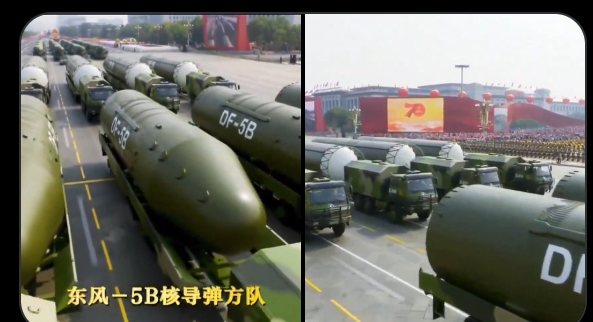
The DF-5B, an upgraded variant of the Cold War-era DF-5, was highlighted by state broadcaster CCTV in a rare disclosure on 3 June 2025. Unlike its predecessor, which carried a single warhead, the DF-5B employs Multiple Independently Targetable Reentry Vehicle (MIRV) technology, enabling it to deliver between six and ten warheads, each capable of striking a different target. With an explosive yield of 3 to 4 megatons, the missile’s warheads dwarf the 15-kiloton Hiroshima bomb, posing a catastrophic threat to urban centres across the United States and Western Europe.

Boasting a range of 12,000 kilometres, the silo-based, liquid-fuelled missile can strike targets with a precision of 300 to 500 metres, thanks to advanced inertial and satellite-guided navigation systems. Its ability to overwhelm missile defence systems, such as the US Ground-based Midcourse Defense (GMD) and Aegis BMD, stems from its MIRV configuration, which complicates interception by requiring multiple defensive strikes for a single missile.
The public unveiling, described as unusual by analysts, follows China’s first acknowledged ICBM test in decades, conducted in 2023, and comes amid heightened tensions with the United States, particularly in the Indo-Pacific region. US Defence Secretary Pete Hegseth recently called for a repositioning of American forces to counter China’s growing missile capabilities, a move Beijing appears to be addressing directly with this display. Former People’s Liberation Army instructor Song Zhongping suggested the announcement signals China’s intent to phase out older systems while introducing even more advanced ICBMs, potentially including the DF-5C, which may carry up to ten warheads.
The timing of the reveal, shortly after the 2025 Shangri-La Dialogue where the US underscored its focus on countering China’s military expansion, suggests a deliberate message of deterrence. Beijing’s state media described the DF-5B as a cornerstone of China’s nuclear strategy, reinforcing its “No First Use” policy while showcasing its second-strike capability. The missile’s deployment in fortified silos across central China enhances its survivability against pre-emptive strikes.
Analysts, including Matt Korda of the Federation of American Scientists, noted that the public focus on the DF-5B indicates a shift in China’s typically secretive approach, possibly aimed at projecting confidence and deterring adversaries. The Pentagon estimates China’s nuclear arsenal now exceeds 600 warheads, with projections of reaching 1,000 by 2030, supported by the construction of over 300 new ICBM silos across the country.
As global tensions rise, the DF-5B’s capabilities have sparked renewed calls for arms control talks. However, Beijing’s emphasis on matching or exceeding adversaries’ escalation capabilities, as highlighted by Professor Andrew Erickson of the Naval War College, suggests a complex strategic landscape ahead. The missile’s unveiling underscores China’s ambition to assert itself as a world-class military power, raising critical questions about strategic stability in an increasingly volatile world.
