


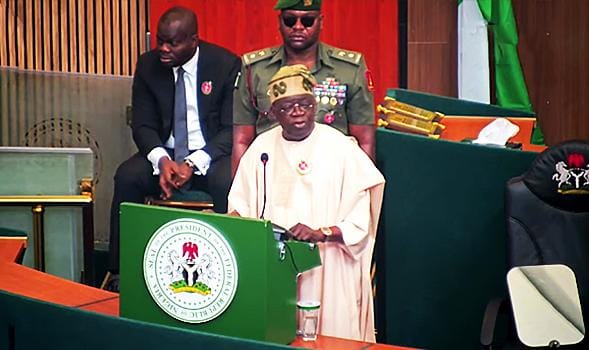
President Tinubu Seeks Senate Approval For £16.9 Billion Borrowing Plan To Boost Nigeria’s Infrastructure And Economy.
President Bola Tinubu has submitted a request to the Nigerian Senate for approval to borrow $21.5 billion (£16.9 billion), including a (£55 million) grant, to fund critical infrastructure projects and stimulate economic growth. The announcement, detailed in a letter to the Senate on 27 May 2025, underscores the government’s growing debt issues aiming to address Nigeria’s infrastructure deficit and mitigate the economic impact of the fuel subsidy removal.
In his letter, President Tinubu outlined the objectives of the 2025-2026 External Borrowing Plan, stating, “This initiative aims to generate employment, promote skill acquisition, foster entrepreneurship, reduce poverty, and enhance food security, as well as to improve the livelihoods of Nigerians.” The proposed funds, totalling $21,543,647,912 billion, and a €65 million grant, will support projects spanning all 36 states and the Federal Capital Territory, with a focus on transformative infrastructure such as railways and healthcare facilities.

The President highlighted the necessity of the borrowing plan, citing the significant financial shortfall caused by declining domestic revenue and the urgent need to stabilise the economy. “In light of the significant infrastructure deficit in the country and the power of financial resources needed to address this gap amid declining domestic demand, it has become essential to pursue prudent economic borrowing,” he stated. The funds are expected to drive job creation, improve food security, and enhance living standards across Nigeria.
The borrowing plan comes at a critical time, following the removal of the fuel subsidy, which has strained the national economy. President Tinubu emphasised that the funds would be directed towards high-impact projects to close the infrastructure gap and foster sustainable development. The inclusion of a €65 million grant further demonstrates Nigeria’s efforts to secure concessional financing to complement domestic resources.
The Senate’s approval is pivotal for the timely disbursement of funds and effective project implementation. The government has assured Nigerians that the borrowing plan has been carefully designed to align with the country’s economic priorities, ensuring transparency and accountability in the utilisation of funds. Key projects, including railway expansions and healthcare improvements, are expected to create a ripple effect, boosting economic activity and improving access to essential services nationwide.
This move aligns with President Tinubu’s broader economic agenda, which includes recent infrastructure milestones such as the commissioning of Section I of the Lagos-Calabar Coastal Highway and the Lekki Deep Sea Port Tax Credit Concrete Road, scheduled for 31 May 2025. These projects reflect the administration’s focus on leveraging strategic investments to drive long-term growth.
As the Senate deliberates on the borrowing request, Nigerians await the potential economic benefits of these investments. The government has called for public support, emphasising that the funds will be managed prudently to deliver tangible improvements in infrastructure, employment, and quality of life.
