


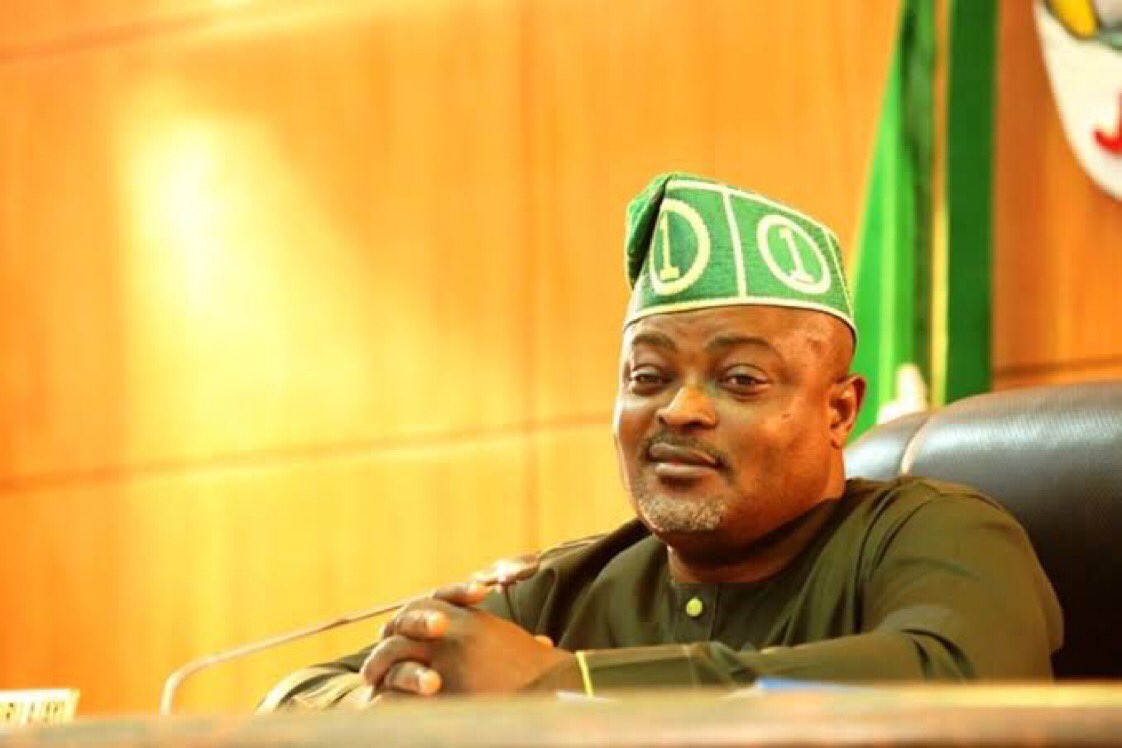
“Obasa’s Impeachment Drama: Defiance Amidst Political Upheaval in Lagos”.
Mudashiru Obasa, the former Speaker of the Lagos State House of Assembly, has recently addressed his impeachment, asserting his legitimacy and refuting claims of corruption. He was impeached on January 13, 2025, over allegations of gross misconduct, abuse of office, and financial impropriety, including a notable claim of a ₦43.5 billion expenditure on backup vehicles for lawmakers.
Obasa has publicly challenged the process that led to his removal, stating that the impeachment was not conducted according to constitutional procedures. He has expressed confidence despite the situation, indicating that he is “not disturbed” nor “afraid” of the developments at the Assembly. He particularly dismissed the allegations of financial mismanagement, including the controversial claim that ₦16 billion was spent on a gate, which he referred to dismissively as not being the “wall of Jericho.” Obasa has also stated that if he is no longer the Speaker, it is not the end of his world, emphasizing that claims of corruption against him must be proven.

His supporters, particularly from his Agege constituency, have rallied behind him, dismissing the allegations as politically motivated. They’ve expressed concerns over the process and the validity of the accusations, suggesting that there might be political motives behind the impeachment, especially given Obasa’s rumored ambitions for the 2027 Lagos governorship race.
The impeachment has been described by some political analysts as a “self-inflicted own goal,” suggesting that Obasa’s actions, including remarks perceived as disrespectful toward Governor Babajide Sanwo-Olu and other political leaders, may have contributed to his downfall. There have been reports of President Bola Tinubu’s involvement, or at least awareness, of the situation, although the APC has clarified that the impeachment was the Assembly’s independent decision.
The new Speaker, Mojisola Meranda, who replaced Obasa, has been meeting with key political figures to consolidate her position, indicating a significant shift in leadership within the Assembly.
Obasa’s legal credentials have also come under scrutiny, with a Supreme Court document from 2020 revealing that he was not registered as a legal practitioner, which adds another layer of controversy to his political career.
This situation has sparked a wide range of reactions and discussions on social media and among political commentators about the implications for Lagos state politics, the integrity of the legislative process, and the future of Obasa’s political career.
