


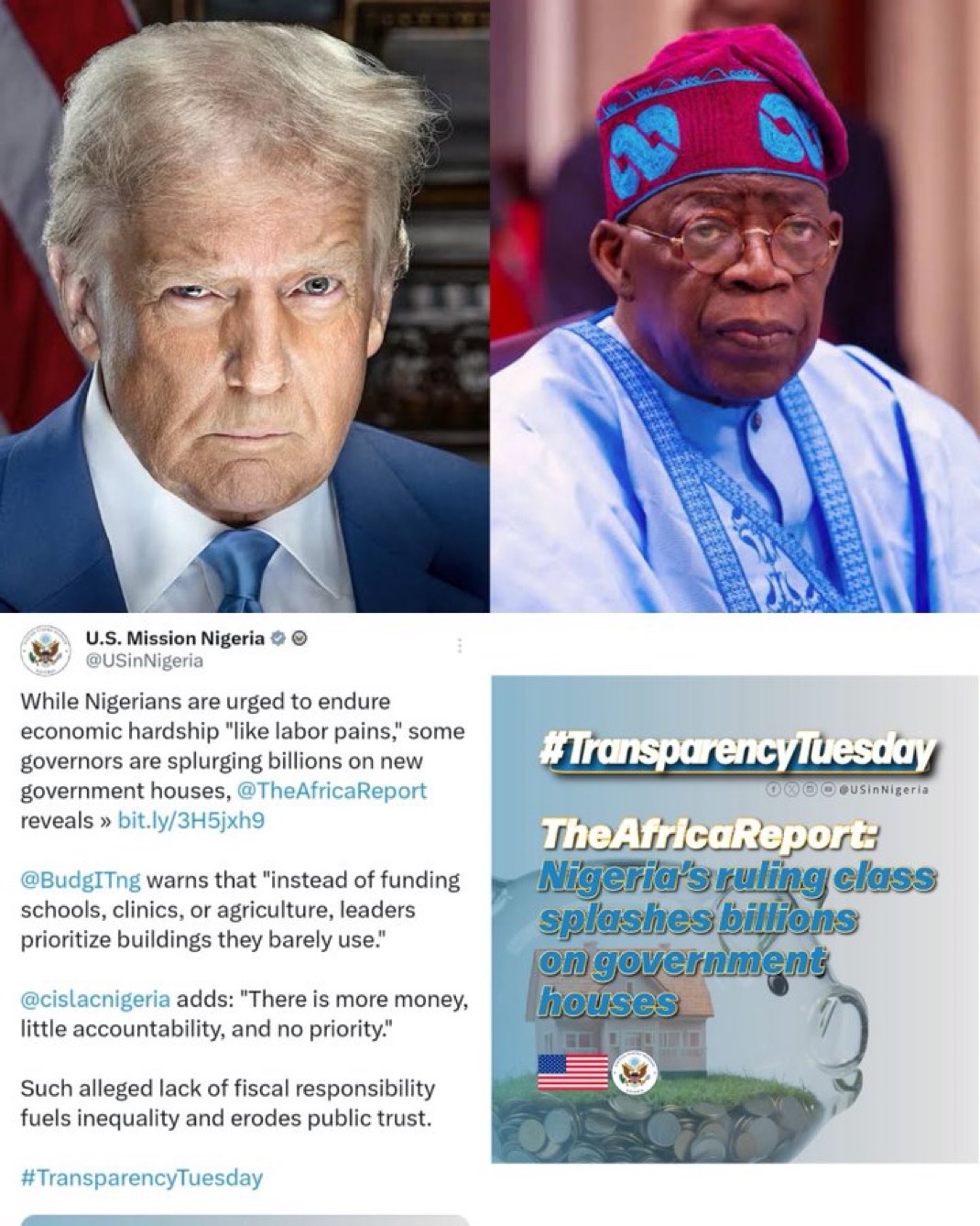
Nigerian Leaders Criticised For Lavish Spending By U.S Amid Economic Hardship.
The United States Mission in Nigeria has sparked widespread discussion with a statement highlighting the stark contrast between the Nigerian ruling class’s lavish expenditure and the economic challenges faced by ordinary citizens. The mission’s comment, posted on 29th July 2025, noted that while billions are being spent by the elite, Nigerians are being urged to endure ongoing economic hardship.
The statement, which has gained significant traction on social media platforms, reflects growing concerns about financial mismanagement in Nigeria, Africa’s largest economy. Reports indicate that top officials have allocated substantial sums to projects such as the construction and renovation of government residences, including a reported ₦21 billion for the Vice President’s residence and significant expenditures on state governor houses. These developments come at a time when the nation grapples with soaring inflation, which reached nearly 30% in 2024, and a cost-of-living crisis that has left millions struggling to afford basic necessities like food and fuel.

President Bola Tinubu, since taking office in May 2023, has called for shared sacrifice, likening Nigeria’s economic difficulties to temporary “labour pains” that will yield long-term benefits. His administration’s reforms, including the removal of the fuel subsidy and the unification of the exchange rate, have been praised for aiming to stabilise the economy but have also driven up prices, exacerbating hardship for many. The government has introduced measures such as distributing 42,000 tonnes of grains and establishing a board to regulate food prices, though critics, including labour unions, argue these efforts have been insufficient and poorly executed.
The U.S. Mission’s statement has amplified public frustration, with many Nigerians expressing outrage over the perceived disconnect between the ruling class and the populace. Social media posts have echoed sentiments of betrayal, accusing leaders of prioritising personal luxury over public welfare. The criticism comes amid broader international scrutiny of Nigeria’s governance, with the U.S. and other partners urging greater transparency and accountability in public spending.
Despite the controversy, the Tinubu administration has defended its economic policies, asserting that they are necessary for long-term growth. The government has also highlighted international support, including over $1.2 billion in U.S. assistance in 2022 for health, education, and security, as evidence of Nigeria’s strategic importance. However, with 87 million Nigerians living below the poverty line in 2023, the second-highest globally, calls for more equitable resource allocation are growing louder.
The U.S. Mission’s remarks have reignited debates about governance and economic priorities in Nigeria. As the nation navigates these turbulent times, the government faces increasing pressure to address public discontent and demonstrate tangible progress in alleviating hardship. With Nigeria poised to become the world’s fourth-most populous country by 2050, the need for inclusive and sustainable economic policies has never been more urgent.
