


Nigeria Set To End Diesel Dependency And Slash Carbon Emissions, Says Vice President Shettima.
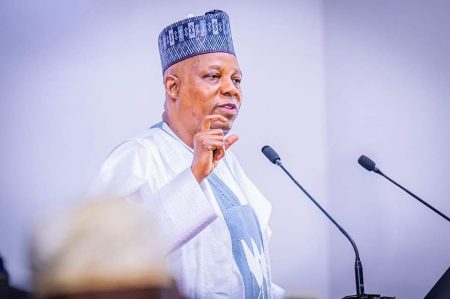
Vice President Kashim Shettima has announced an ambitious plan for Nigeria to phase out diesel dependency and significantly reduce carbon emissions through the adoption of an integrated hybrid energy system. Speaking at the Decarbonising Infrastructure in Nigeria Summit (DIN Summit) in Abuja on Wednesday, 2 July 2025, Shettima outlined the government’s commitment to transforming the nation’s infrastructure to align with sustainable development goals.

Shettima emphasised that 75% of Nigeria’s greenhouse gas emissions stem from the infrastructure sector, encompassing energy, transport, urban development, and agriculture. These sectors, he noted, are not only carbon-intensive but also the backbone of the nation’s economy, with agriculture supporting over 70% of rural livelihoods. “The only way out of the predicted doom is to decarbonise these systems,” he declared, stressing that climate action is now an economic necessity rather than a luxury.
A key highlight of the Vice President’s address was the plan to transform Onne Port in Rivers State into Nigeria’s first fully green port. Discussions are underway with private investors to secure nearly $60 million to electrify the port using a hybrid energy system. “This is a strategic leap,” Shettima said. “Through an integrated hybrid energy system, we will phase out diesel dependency, slash carbon emissions, and provide 24/7 sustainable and affordable power to terminal operators and port users.”
The initiative is part of Nigeria’s broader Energy Transition Plan and Climate Change Act, which Shettima described as a “visionary and pragmatic” roadmap for sustainable development. He projected that successful implementation of these climate strategies could generate over 1.5 million green jobs by 2035, create new export markets in clean energy and climate-smart agriculture, and position Nigeria as a regional leader in low-carbon enterprise.
Shettima also highlighted the need for private sector investment in sustainable infrastructure, particularly in energy systems and transportation. Dr. Nkiruka Maduekwe, Director-General of the National Council on Climate Change, echoed this call, identifying smart agriculture practices, renewable energy adoption, and improved land management for carbon sequestration as priority areas for transformation. Musaddiq Mustapha Adamu, Personal Assistant to the President on Subnational Infrastructure, further underscored the administration’s commitment to driving climate innovation at the subnational level.
The Vice President described the summit’s theme, “Unlocking Climate Finance for Sustainable Development,” as timely, noting that Nigeria faces the urgent task of decoupling its economic growth from carbon-intensive models without leaving any citizen behind. “We are not here to fantasise. We are here to finance, mobilise, de-risk, and build,” he said. “The Nigeria we want cannot be realised on diesel generators and fragile grids. We must build a Nigeria whose infrastructure heals rather than harms.”
This announcement comes amid rising diesel prices, with the National Bureau of Statistics reporting an average of N1,758.26 per litre in May 2025. Shettima’s pledge to phase out diesel dependency signals a bold step towards addressing both environmental and economic challenges, positioning Nigeria as a leader in Africa’s green transition.
