


NASA Capsule Safely Returns Stranded Crew To Earth Nine Months After Space Mission.
A NASA space capsule carrying astronauts Butch Wilmore and Suni Williams has successfully landed in the Atlantic Ocean off the coast of Florida, marking the end of their latest mission aboard the International Space Station (ISS).
The spacecraft, which had been travelling at speeds of over 17,000mph, made a dramatic re-entry into Earth’s atmosphere before deploying its parachutes and splashing down safely. The capsule is now set to be retrieved by a recovery vessel, after which the crew will be airlifted back to land via helicopter.

Smooth Descent and Splashdown
During re-entry, the spacecraft experienced a temporary communications blackout, a routine occurrence caused by intense heat and plasma buildup around the capsule’s heat shield. However, once signal was restored, mission control confirmed that the parachutes had successfully deployed, ensuring a smooth descent into the ocean.
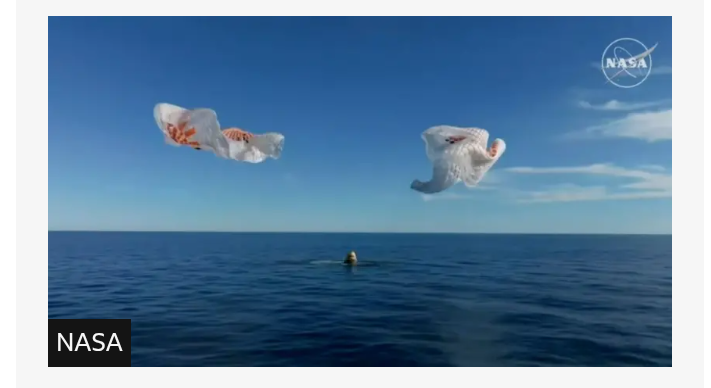
The initial two parachutes slowed the craft down significantly, before four fully deployed, allowing for a controlled splashdown. The astronauts, who had been monitoring the descent on their onboard touchscreen, experienced a brief jolt but remained safe throughout the process.
Autonomous Flight and Recovery Process
The capsule, operating autonomously, required minimal input from the astronauts during its return journey. With their visors down and tablets stowed, the crew primarily observed the descent until landing.
A recovery team is now en route to retrieve the capsule, after which Wilmore and Williams will be transported back to NASA facilities for medical checks and debriefing.
Political Controversy Surrounding the Mission
The mission had become the subject of political debate after SpaceX CEO Elon Musk and US President Donald Trump suggested that the astronauts’ return was delayed due to political reasons. NASA officials, however, dismissed these claims, stating that the decision to keep the astronauts in space was based purely on flight schedules and operational requirements aboard the ISS.
Former NASA astronaut Garrett Reisman supported this view, explaining that an emergency rescue mission would have been both costly and unnecessary, saving only a few months of space time while requiring hundreds of millions of dollars.
A Successful Mission Conclusion
Despite the political debate, the mission has been deemed a success, with Wilmore and Williams completing their objectives aboard the ISS before making a safe return to Earth. Their landing marks yet another milestone in NASA’s continued space exploration efforts, as preparations continue for future missions beyond low-Earth orbit.
