


Mysterious Radio Waves Detected Beneath Antarctica’s Ice Baffle Scientists.
Scientists working in the remote expanse of Antarctica have uncovered a puzzling phenomenon: mysterious radio waves emanating from beneath the continent’s thick ice sheets. The discovery, made by the Antarctic Impulsive Transient Antenna (ANITA) experiment, has left researchers questioning established principles of particle physics and hinting at the possibility of undiscovered phenomena.
ANITA, a NASA-funded project involving an international team including scientists from Penn State, uses balloon-borne instruments flown 40 kilometres above the Antarctic ice to detect radio waves from cosmic rays interacting with the atmosphere. The experiment, designed to study elusive neutrinos—nearly massless particles that rarely interact with matter—has instead picked up unexpected signals. These radio pulses, detected at steep angles of up to 30 degrees below the ice surface, suggest the waves originated deep underground, a scenario that defies current scientific understanding.

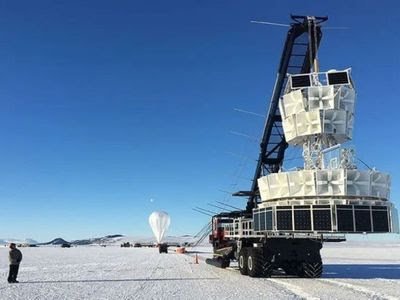
Stephanie Wissel, an associate professor of physics at Penn State and a key member of the ANITA team, explained that these signals should have been absorbed after passing through thousands of kilometres of rock and ice. “The radio waves we detected were at really steep angles, like 30 degrees below the surface of the ice,” Wissel said. “By our calculations, the anomalous signal had to pass through and interact with thousands of kilometres of rock before reaching the detector, which should have left the radio signal undetectable.”
The findings, published in the journal Physical Review Letters, indicate that the signals do not align with known neutrino emissions. Cross-referencing with data from other major detectors, such as IceCube in Antarctica and the Pierre Auger Observatory in Argentina, revealed no matching events, further classifying the signals as “anomalous.” This has led to speculation about potential new physics, including the possibility of unknown particles or interactions, though dark matter remains a tentative hypothesis without conclusive evidence.
Wissel and her colleagues are cautious, suggesting that the signals might result from unusual radio propagation effects near the ice or horizon, a theory yet to be fully explored. To unravel the mystery, the team is developing PUEO, a more sensitive successor to ANITA, which they hope will detect additional anomalies and provide clarity. “I’m excited that when we fly PUEO, we’ll have better sensitivity,” Wissel noted. “In principle, we should pick up more anomalies, and maybe we’ll actually understand what they are.”
For now, the source of these enigmatic waves remains elusive, sparking both scientific curiosity and public intrigue. As researchers prepare for future missions, Antarctica’s icy depths continue to guard a secret that could reshape our understanding of the universe.
