


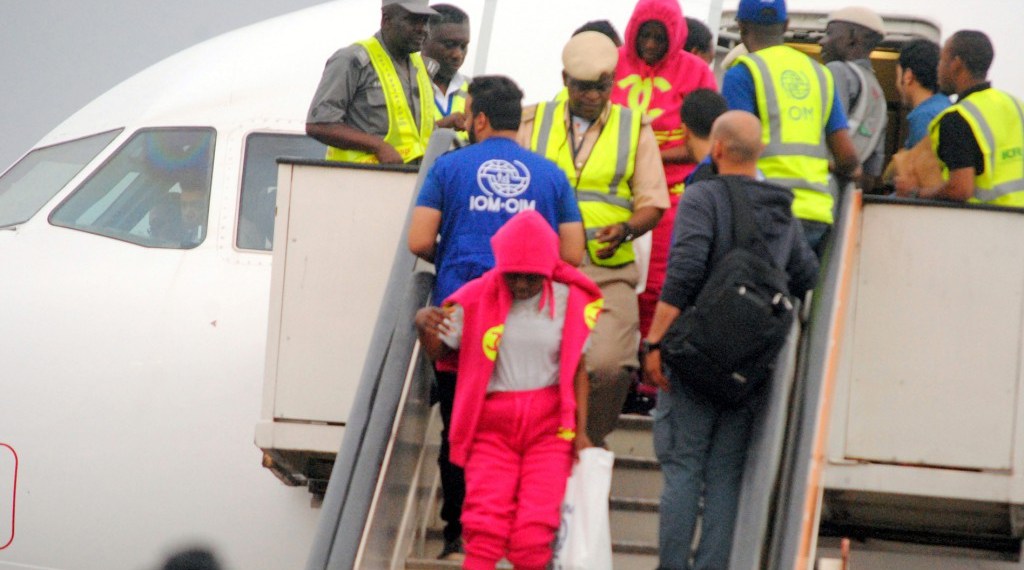
Ireland Deports 35 Nigerians Over Immigration Offences In Major Crackdown.
In a significant move to enforce immigration laws, the Republic of Ireland has deported 35 Nigerian nationals for various immigration-related offences. The group, comprising 21 men, nine women, and five children, was removed from the country on a chartered flight that departed Dublin Airport on the night of Wednesday, 4 June 2025, and landed in Nigeria on Thursday morning.
The operation, orchestrated by the Garda National Immigration Bureau (GNIB) in collaboration with the Department of Justice, marks Ireland’s first chartered deportation flight to Africa this year and the third such operation since the resumption of charter flights in February 2025. A Garda spokesperson confirmed that all five children were part of family units, ensuring no unaccompanied minors were involved in the removal.

Justice Minister Jim O’Callaghan hailed the operation as a success, emphasising the importance of a robust immigration framework. “Ireland has a rules-based immigration system. It is vital that those rules are upheld and enforced to maintain fairness and order,” he stated. “People coming to Ireland must follow the appropriate pathways for legal migration. If a person’s application for international protection is refused and they are ordered to leave the State, they must do so.”
The deportation follows a rigorous process, with individuals initially offered the chance to return voluntarily. The Department of Justice highlighted that voluntary return remains the preferred method, with 934 people opting for this route in 2024, a sharp rise from 213 the previous year. However, for those who do not comply, enforced removal via charter or commercial flights is pursued. This latest operation brings the total number of people deported by charter flight in 2025 to 106, following earlier removals of 71 individuals to Georgia.
The flight, costing €325,000, faced a brief delay due to an unscheduled stop prompted by a medical incident on board. The issue was swiftly resolved, and all 35 deportees arrived safely in Nigeria. Minister O’Callaghan defended the expenditure, describing it as “value for money” for a “difficult and challenging job” carried out by An Garda Síochána, Department of Justice staff, and prison officers.
The move underscores Ireland’s firm stance on immigration enforcement, with 1,386 deportation orders signed this year as of 30 April 2025, and 647 individuals having left the State through enforced or voluntary mechanisms. The Department of Justice noted that access to chartered aircraft has bolstered the GNIB’s capacity to execute removals efficiently, particularly for groups heading to the same destination. Further charter operations are planned for later this year.
The Irish Refugee Council, however, expressed concern, labelling the government’s focus on deportation as “deeply troubling.” In a statement to RTÉ News, the council argued that forced removals are “costly and ineffective,” often tearing people from communities they have integrated into, including the five children deported in this instance.
This operation has sparked debate about Ireland’s immigration policies, balancing the enforcement of rules with humanitarian considerations. As the government presses forward with its commitment to a “robust, fair, efficient, and enforced” system, the plight of deportees and their families continues to draw attention both in Ireland and Nigeria.
