


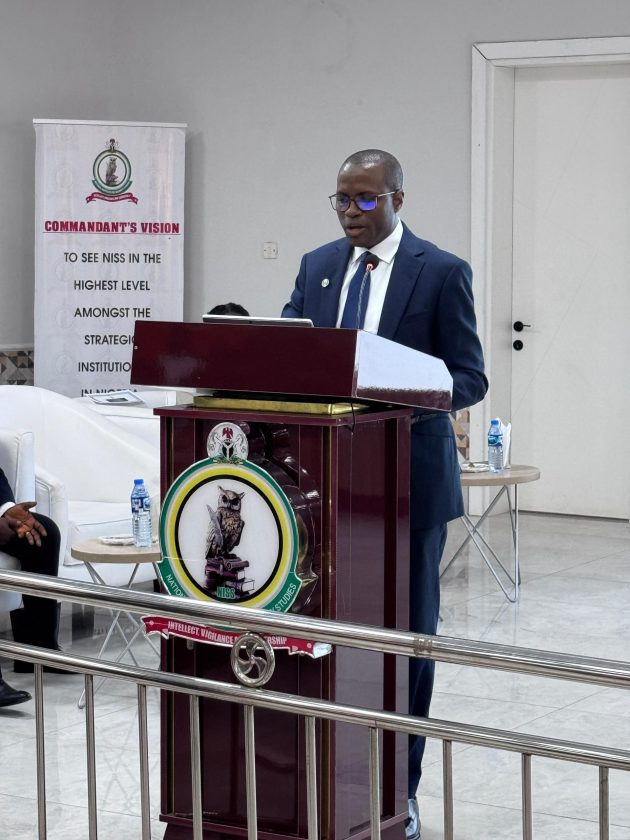
ICPC Chairman Calls For Transparent Judicial Appointments To Combat Corruption In Africa.
Dr. Musa Adamu Aliyu, SAN, Chairman of the Independent Corrupt Practices and Other Related Offences Commission (ICPC), has urged greater transparency in the appointment of judges as a vital step in tackling corruption across Africa. Speaking on Monday at the National Institute for Security Studies (NISS) in Lower Usuma Dam, Bwari, Abuja, Dr. Aliyu delivered a compelling lecture titled “Non-State Actors and Anti-Corruption Efforts in Africa” to participants of the Executive Intelligence Management Course 18 (EIMC 18).

Dr. Aliyu stressed that appointing credible, principled judges is essential to curbing corruption, advocating for a transparent selection process overseen by bodies like Nigeria’s National Judicial Council (NJC). “For many years, the Nigerian Bar Association has called for the NJC to publish the names of prospective judges to allow public scrutiny and input,” he said. Drawing from his own experience, he noted, “When I was appointed a Senior Advocate of Nigeria, my name was published, and the public was invited to testify about my character. Why should the appointment of judges be any different?”
He argued that transparent judicial appointments would ensure that knowledgeable and ethical judges, who uphold the rule of law, occupy the bench, significantly bolstering the fight against corruption. “If we have good judges who are knowledgeable and have the fear of God, they will tackle the challenges of corruption head-on,” Dr. Aliyu asserted.
Highlighting the scale of the challenge, the ICPC Chairman cited the 2024 Corruption Perceptions Index by Transparency International, released on 11 February 2025, which ranked Sub-Saharan Africa as the lowest-scoring region globally, with an average score of 33 out of 100. Nigeria placed 140th out of 180 countries, with 90% of regional countries scoring below 50, reflecting deep-seated perceptions of public sector corruption. Dr. Aliyu also revealed that Africa loses approximately US$88.6 billion annually to Illicit Financial Flows (IFFs), undermining development, exacerbating poverty, and hindering progress towards the United Nations 2030 Agenda and the African Union’s Agenda 2063.
Dr. Aliyu emphasised that anti-corruption agencies alone cannot win the fight against corruption, calling for stronger collaboration with Non-State Actors (NSAs) such as civil society, media, academia, religious institutions, and the private sector. He highlighted their critical role in advocacy, raising public awareness, monitoring corruption, promoting transparency, and supporting whistleblowers. Citing a 2024 case where a whistleblower and a media personality aided the ICPC in recovering approximately N23 billion in looted funds, he underscored the power of collective action.
The Commandant of NISS, J.O. Odama, fsi, fdc, praised Dr. Aliyu for his insightful lecture and extended an open invitation for future engagements. As Nigeria and Africa confront systemic corruption, the ICPC Chairman’s call for transparency and collaboration offers a hopeful path towards a more accountable and prosperous future.
