


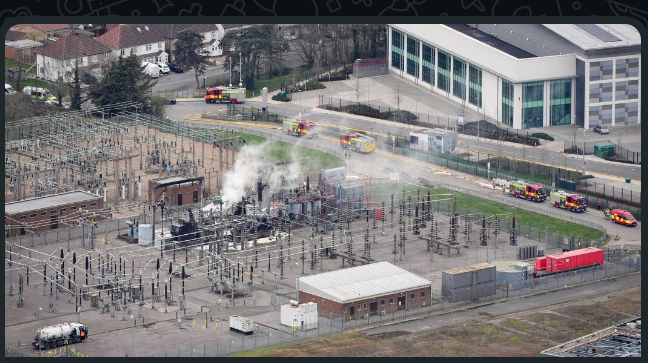
Heathrow Airport Shutdown Caused By Preventable Substation Fire, Report Finds.
A major fire at an electrical substation that brought London’s Heathrow Airport to a standstill for over 12 hours in March 2025 was caused by a short circuit in a poorly maintained component, a report by Britain’s National Energy System Operator (NESO) has revealed. The blaze, which disrupted more than 1,000 flights and affected around 270,000 passengers, exposed significant vulnerabilities in the UK’s critical infrastructure, prompting calls for urgent improvements.

The fire broke out just before midnight on 20 March at the North Hyde substation in Hayes, approximately 1.5 miles from Heathrow, one of the world’s busiest airports. The blaze, fuelled by 25,000 litres of cooling oil in a transformer, caused a “catastrophic failure” due to moisture entering a high-voltage bushing, a component that had not been maintained since July 2018. According to the NESO report, National Grid, which operates the substation, had detected elevated moisture levels seven years earlier but failed to address the issue, with scheduled maintenance repeatedly cancelled. This oversight led to a short circuit that sparked the fire, knocking out both the primary transformer and its backup, leaving two of Heathrow’s four terminals without power.
The outage forced the cancellation of over 1,300 flights, with planes diverted to airports across the UK and Europe, including Gatwick, Paris Charles de Gaulle, and Shannon in Ireland. Passengers faced significant disruption, with many stranded worldwide, and airlines reported losses estimated at £80m to £100m. The fire also cut power to 66,919 homes and businesses, including Hillingdon Hospital, and disrupted rail and coach services to the airport. Emergency services, including 70 firefighters, worked through the night to control the blaze, evacuating 29 people from nearby properties with no reported casualties.
Heathrow’s chief executive, Thomas Woldbye, described the incident as “unprecedented,” noting that the airport’s backup systems, including diesel generators and uninterruptible power supplies, were insufficient to maintain full operations, which require the energy equivalent of a small city. While power was restored by 06:25 on 21 March using alternative substations, full operations did not resume until the following day after extensive safety checks. Woldbye defended the airport’s response, stating that safety concerns necessitated the closure, but faced criticism from airline leaders like Willie Walsh of the International Air Transport Association, who called the reliance on a single substation a “clear planning failure.”
Energy Secretary Ed Miliband labelled the findings “deeply concerning,” announcing that Ofgem, the energy regulator, has launched an enforcement investigation into National Grid for potential licence breaches related to the substation’s maintenance, built in the 1960s. The report highlighted that energy companies were unaware that losing one of Heathrow’s three supply points could cripple critical systems, raising broader questions about the resilience of the UK’s ageing infrastructure. Prime Minister Keir Starmer echoed these concerns, stressing the need for answers to prevent future disruptions.
National Grid acknowledged the incident’s severity, describing it as “extraordinarily rare” and confirming that it has since re-tested the resilience of substations serving critical infrastructure. Heathrow has commissioned an independent review, led by former transport secretary Ruth Kelly, to examine its response and enhance future preparedness. As the airport handles a plane every 45 seconds and serves over 83 million passengers annually, the incident has underscored the urgent need for robust backup systems to safeguard one of Britain’s most vital transport hubs.
