


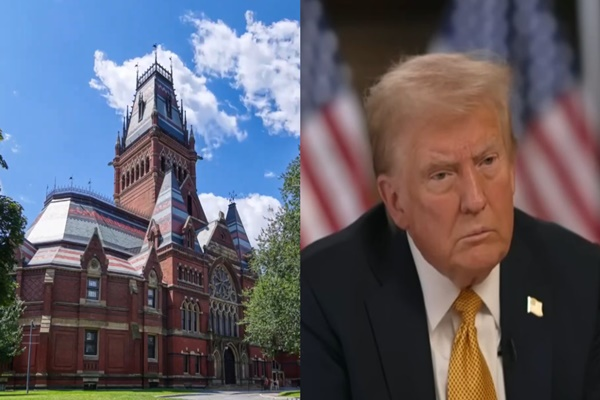
Harvard Sues Trump Administration Over Ban On International Student Enrolment.
Harvard University has launched a legal challenge against the Trump administration, branding its decision to bar the Ivy League institution from enrolling international students as an “unlawful” and “unconstitutional” act of retaliation. The lawsuit, filed on Friday in a federal court in Boston, comes just hours after the US Department of Homeland Security (DHS) revoked Harvard’s certification to enrol foreign students under the Student and Exchange Visitor Program (SEVP), effective for the 2025-2026 academic year.
The abrupt move by DHS, announced on Thursday by Homeland Security Secretary Kristi Noem, threatens the academic futures of nearly 7,000 international students, who make up approximately 27% of Harvard’s student body. The university condemned the decision as a “blatant violation” of the First Amendment, the Due Process Clause, and the Administrative Procedure Act, arguing that it is a direct response to Harvard’s refusal to comply with the administration’s demands for extensive records on foreign students and changes to its admissions and hiring practices.

In a swift response, US District Judge Allison Burroughs, an appointee of former President Barack Obama, issued a temporary restraining order on Friday morning, halting the ban’s implementation. Judge Burroughs ruled that Harvard had demonstrated the policy would cause “immediate and irreparable injury” to the university and its international students. Hearings are scheduled for 27 and 29 May to determine further steps in the case.
Harvard President Alan M. Garber described the revocation as “unlawful and unwarranted,” emphasising the vital role international students play in the university’s community. “Without its international students, Harvard is not Harvard,” the university stated in its 72-page lawsuit, highlighting that students from over 140 countries enrich both the institution and the United States. Garber assured affected students and scholars that Harvard would “do everything in its power” to support them, adding, “Thanks to you, we know more and understand more, and our country and our world are more enlightened and more resilient.”
The Trump administration’s decision follows months of escalating tensions with Harvard, which has resisted demands to align its policies with the president’s agenda. The administration has accused the university of fostering “anti-American, pro-terrorist agitators” and coordinating with the Chinese Communist Party, allegations Harvard has firmly denied. The DHS also froze $2.2 billion in federal grants and $60 million in contracts to Harvard in April after the university refused to overhaul its governance, admissions, and diversity, equity, and inclusion policies.
Noem’s letter to Harvard stated that the university could regain its SEVP certification by submitting five years’ worth of records on foreign students’ conduct within 72 hours, a demand the lawsuit argues lacks statutory or regulatory authority. White House spokesperson Abigail Jackson dismissed Harvard’s legal action, stating, “If only Harvard cared this much about ending the scourge of anti-American, anti-Semitic, pro-terrorist agitators on their campus, they wouldn’t be in this situation to begin with.”
The move has drawn international criticism, with Germany’s research minister, Dorothee Baer, calling it “fatal” and former German health minister Karl Lauterbach labelling it “research policy suicide.” China’s Foreign Ministry also condemned the action, vowing to protect the rights of its students, who represent the largest group of Harvard’s international cohort at around 1,016 in the 2024-2025 academic year.
Harvard’s lawsuit is the latest in a series of legal battles with the Trump administration, including a previous suit to restore $3 billion in frozen federal funding. Unlike some institutions, such as Columbia University, which reached settlements after similar threats, Harvard has taken a defiant stance, arguing that the administration’s actions undermine academic freedom and the contributions of international students to American society.
The university’s student newspaper, The Harvard Crimson, wrote in an editorial, “Harvard’s international students are people — not pawns,” questioning how deporting students, including Jewish and Israeli students, addresses the administration’s stated concerns about antisemitism. As the legal fight unfolds, the case is likely to have significant implications for higher education and immigration policy in the United States.
