


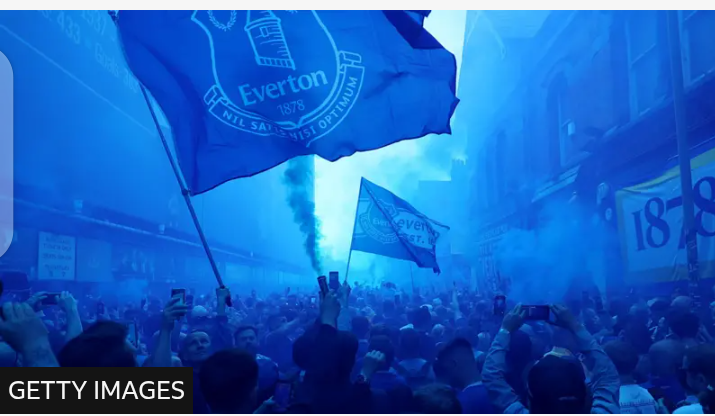
Goodison Park Bids Emotional Farewell As Everton Triumph In Historic Final Match.
Blue smoke billowed around Goodison Park hours before kick-off, a fittingly raucous prelude to an emotional day that marked the end of 133 years of men’s senior football at Everton’s storied home. The grand old stadium, nestled three miles from Liverpool’s city centre, was never built for quiet goodbyes, and its passionate supporters ensured this historic farewell was anything but subdued.
Everton delivered a fitting 2-0 victory over Southampton, with Iliman Ndiaye’s first-half brace sealing a triumphant send-off. But the match itself was almost a sideshow, briefly interrupting a day of celebration, reflection, and raw emotion as Evertonians gathered to honour their beloved Goodison Park.

From 8am, thousands thronged the streets, rendering Goodison Road near impassable. Everton’s team coach, shrouded in blue smoke, was forced to divert to Bullens Road to reach the stadium. Fans, young and old, flocked to the club’s iconic landmarks – the ‘Holy Trinity’ statue honouring the 1970 title-winning midfield of Alan Ball, Colin Harvey, and Howard Kendall, and the statue of Dixie Dean, whose record 60 league goals in 1927-28 remains untouched. These monuments will remain as Everton prepares to relocate to the state-of-the-art 53,000-capacity Hill Dickinson Stadium at Bramley-Moore Dock.
Local haunts like The Blue House, The Winslow Hotel’s Howard Kendall Bar, Blue Dragon fish bar, and The Goodison Cafe were packed, their tills ringing as fans soaked up the atmosphere. The terraced houses of Winslow Street, Eton Street, Neston Street, and Andrew Street, which have long hemmed in Goodison, buzzed with supporters – some with tickets, others simply there to be part of history.
Inside the stadium, the air raid siren blared, and tears flowed as the familiar drumbeat of Everton’s ‘Z Cars’ anthem echoed. The stands, including the Main Stand and the Archibald Leitch-designed Bullens Road Stand, were a sea of royal blue, rocking with emotion. A hush fell in the second half as fans, with the game won, braced for the final whistle. When referee Michael Oliver blew to signal the end, a wall of sound erupted, ushering in heartfelt celebrations.
Video tributes from football luminaries, including England head coach Thomas Tuchel, lauded Goodison’s unique atmosphere. Former Evertonians, now scattered across the globe, sent messages of love. Arsenal manager Mikel Arteta and Carlo Ancelotti, who managed Everton before returning to Real Madrid, received warm ovations. Over 70 former players, including Tim Cahill, Gary Stevens, Paul Rideout, Bob Latchford, and Graeme Sharp, attended, with Wayne Rooney welcomed back as a hometown hero. A violinist’s poignant rendition of ‘Z Cars’ brought more tears as the players were paraded before the fans.
Manager David Moyes, set to lead Everton into their new era, captured the day’s spirit. “This was an extraordinary atmosphere,” he said. “The crowd were amazing, inside and outside. It was as if everyone came together as one club. The support at Everton is immense. Goodison Park will be remembered for one thing – the people.”
Moyes, who coined the term “The People’s Club” upon joining in 2002, urged Everton’s new American owners, The Friedkin Group, to harness this passion. “I hope the owners recognise what they’re seeing here,” he said. “This should be bottled up and taken to the Mersey. We need to rebuild Everton and make great teams again.”
While Goodison will live on as the home of Everton’s women’s team, recreating its heart and soul at Bramley-Moore Dock will be no small feat. As former striker Andy Gray, a title and European Cup Winners’ Cup winner, put it: “We will leave Goodison Park. Goodison Park will never leave us.”
The day closed with a lone trumpeter playing a mournful ‘Z Cars’, as thousands lingered in their seats, reluctant to leave the place they’ve called home. Tears of joy, sorrow, and pride mingled in a fitting tribute to a stadium that has seen it all. As Everton dubbed it, this was truly the end of an era.
