


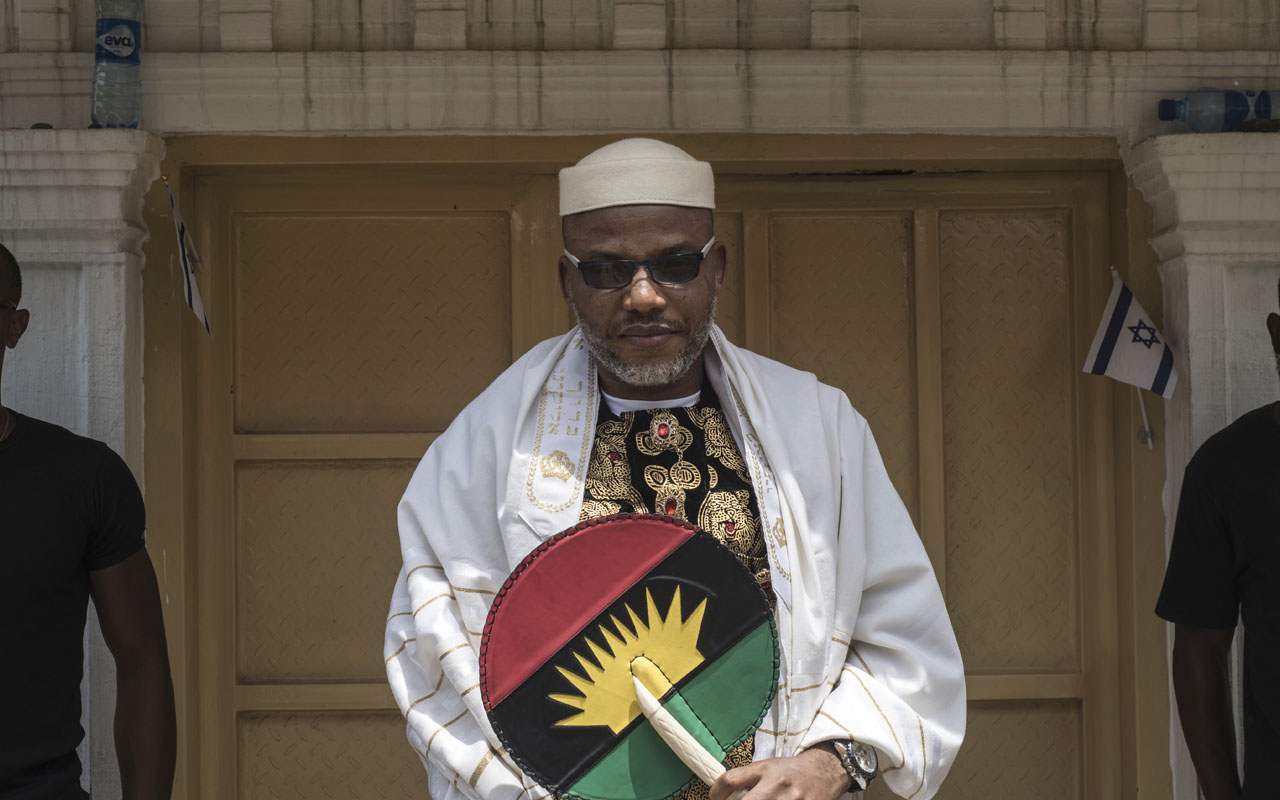
DSS Claims Nnamdi Kanu’s Radio Broadcasts Incited Violence And Harmed South-East Economy.
The Department of State Services (DSS) has alleged that radio broadcasts by Nnamdi Kanu, leader of the proscribed Indigenous People of Biafra (IPOB), incited violence and caused significant economic disruption in Nigeria’s South-East region. The claims were presented during a Federal High Court hearing in Abuja on Friday, 13 June 2025, as part of Kanu’s ongoing terrorism and treason trial.
A DSS operative, identified only as Mr. DDD for security reasons, testified before Justice James Omotosho, stating that Kanu’s broadcasts on Radio Biafra encouraged violent enforcement of IPOB’s sit-at-home orders through its armed wing, the Eastern Security Network (ESN). The witness claimed these actions led to economic paralysis in the South-East, with businesses and public services disrupted due to fear of violence. “The defendant used the radio to incite members of the public against the Federal Government,” Mr. DDD told the court, according to a report by Punch Nigeria.

The DSS further alleged that Kanu smuggled an undeclared radio transmitter into Nigeria, concealed among household items, to evade detection by the Nigerian Customs Service. The device was reportedly stored at the residence of Benjamin Madubugwu in Ihiala, Anambra State. In court, a video was played showing Kanu describing the transmitter as a “game changer” and a “nuclear weapon” for Biafra, while warning South-East residents against defying a sit-at-home order scheduled for 31 May 2021. The prosecution submitted 18 video clips and 16 radio broadcasts attributed to Kanu as evidence.
Additional claims included Kanu’s alleged reaction to the death of ESN commander Nwokike Anyinayo Andy, known as Ikonso, killed by security forces on 24 April 2021. The DSS stated that Kanu mourned Ikonso in a broadcast the following day and vowed revenge. Another broadcast on 29 May 2021 reportedly saw Kanu insult prominent South-East political figures, including former Imo State governors David Umahi and Rochas Okorocha, as well as current governor Hope Uzodinma.
The court also admitted other exhibits, including two unlicensed pump-action guns, ammunition, laptops, and a quantity of marijuana, allegedly linked to Kanu’s activities. A controversial Vanguard newspaper article was presented, claiming an ESN member stated Kanu ordered the collection of 2,000 human heads for burial rites, though only 30 were obtained. Kanu’s defence team objected to the article’s admissibility, but it was accepted alongside a certificate of compliance.
Kanu, a British-Nigerian citizen, has been detained since his re-arrest in Kenya in 2021, following his initial arrest in 2015 and subsequent bail-jumping in 2017. He faces seven counts of terrorism and treason, to which he has pleaded not guilty. During earlier hearings, Kanu denied ordering violence, asserting that IPOB is a peaceful movement seeking self-determination through a referendum. He claimed the ESN was formed to protect South-East communities from armed herdsmen attacks and maintained that his 2017 bail conditions were violated by a military raid on his home, which he said killed 28 people.
The DSS’s allegations have sparked debate, with critics questioning the evidence’s credibility and the government’s handling of Kanu’s case. Human rights groups have previously raised concerns over his 2021 extradition, which Nigeria’s Supreme Court acknowledged violated his rights, though it upheld the continuation of his trial. Observers note that the South-East’s economic challenges are multifaceted, including issues like infrastructure deficits and unemployment, which may not be solely attributable to IPOB’s actions.
The trial continues to draw attention, with Kanu’s legal team, led by Kanu Agabi (SAN), challenging the prosecution’s claims. The court has scheduled further hearings to inspect the seized transmitter and other items held at a DSS facility in the Presidential Villa.
As the case unfolds, the South-East remains tense, with ongoing security challenges complicating efforts to restore stability and economic growth. The outcome of Kanu’s trial may have significant implications for the region and Nigeria’s broader unity.
