


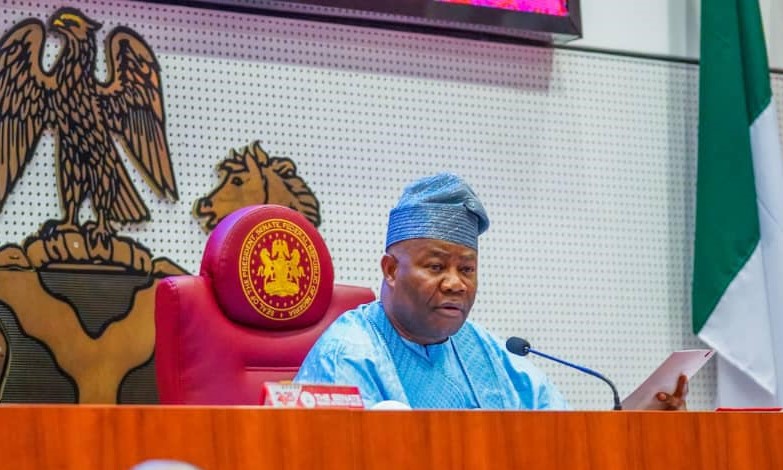
Civil Society Groups Demand Resignation Of Senate President Akpabio Over Electoral Fraud Ruling.
A coalition of 56 prominent Civil Society Organisations (CSOs) in Nigeria has called for the immediate resignation of Senate President Godswill Akpabio following a Court of Appeal ruling that upheld the conviction of Professor Peter Ogban for electoral fraud in the 2019 Akwa Ibom North-West Senatorial election.
The appellate court in Calabar last Wednesday affirmed a three-year prison sentence for Professor Ogban, the returning officer who was found guilty of falsifying election results to secure victory for Akpabio, then a candidate for the All-Progressives Congress (APC). The ruling has sparked widespread concern about the legitimacy of Akpabio’s senatorial mandate and his continued tenure as Senate President.

In a strongly worded joint statement, the CSOs described the court’s decision as a damning indictment of the electoral process that brought Akpabio to the Senate. “This ruling raises serious questions about the credibility of Senator Akpabio’s mandate,” they said. “It is deeply troubling that the election which propelled him to the Senate has been judicially confirmed to have been manipulated. In any democratic society, such a development demands accountability and responsible leadership.”
The organisations argued that, despite Akpabio’s denial of personal involvement, the conviction of the official who declared him the winner casts significant doubt over the integrity of the 2019 election. They urged Akpabio to step aside temporarily until the matter is fully resolved, stressing that his continued presence in office undermines public confidence in Nigeria’s democratic institutions.
The CSOs also raised a critical question about Akpabio’s eligibility to hold office. “Having been a confirmed beneficiary of electoral fraud in the 2019 election to the 9th Senate—a term he did not complete due to his appointment as Minister of Niger Delta—does Senator Akpabio have the legal or moral standing to contest for a seat in the 10th National Assembly, let alone serve as its President?” they asked.
The coalition warned that allowing Akpabio to remain in office amid such serious ethical concerns risks eroding trust in Nigeria’s electoral system ahead of the 2027 general elections. “This is not just about one individual,” they noted. “It is about restoring public faith in our democratic process. Permitting the Senate President to stay in office under these circumstances sends a dangerous signal.”
The CSOs commended the Independent National Electoral Commission (INEC), particularly former Akwa Ibom Resident Electoral Commissioner Mike Igini, for their role in investigating and prosecuting the case. They called on the National Assembly, INEC, and the judiciary to use the ruling as a catalyst for strengthening safeguards against electoral malpractice.
Additionally, the organisations urged the APC leadership to demonstrate its commitment to democratic accountability by initiating a rerun or revalidation process for the Akwa Ibom North-West senatorial seat. “The judiciary has fulfilled its duty,” the CSOs concluded. “It is now incumbent upon the political leadership to show Nigerians and the world that no one is above the law—not even the Senate President.”
The development has intensified scrutiny of Nigeria’s electoral processes, with the CSOs’ demands placing significant pressure on Akpabio and the APC to address the fallout from the ruling.
