


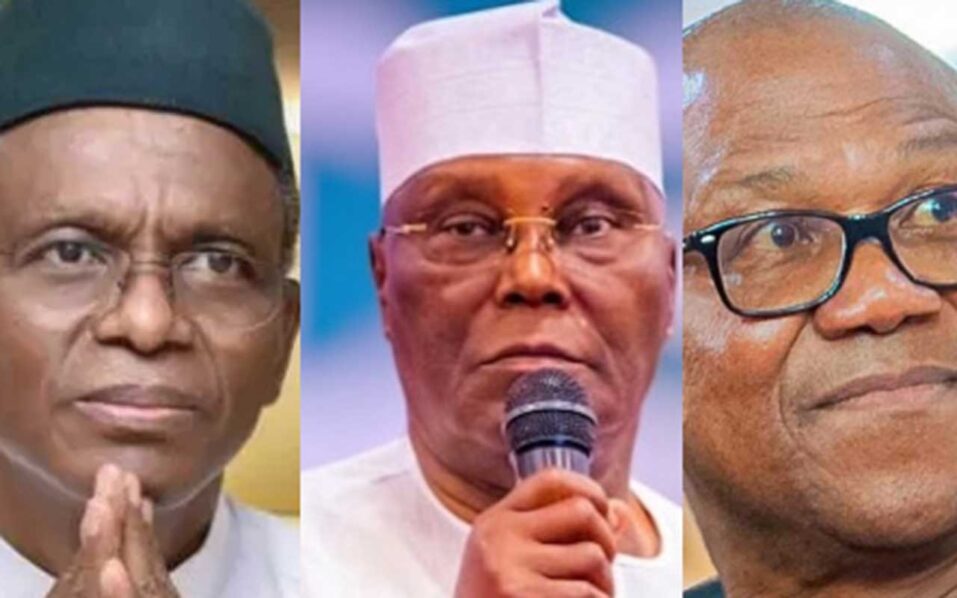
Atiku, Obi, And El-Rufai Unite Under ADC To Challenge Tinubu In 2027 Nigerian Election.
In a significant development for Nigeria’s political landscape, former Vice President Atiku Abubakar of the Peoples Democratic Party (PDP), Peter Obi of the Labour Party (LP), and Nasir El-Rufai of the Social Democratic Party (SDP) have concluded months of discussions to form a coalition under the African Democratic Congress (ADC) ahead of the 2027 presidential election, according to a source cited by Bloomberg. This strategic alliance aims to challenge President Bola Tinubu and the ruling All Progressives Congress (APC) in what promises to be a fiercely contested race.
The trio, prominent figures in Nigerian politics, have reportedly agreed to unite their efforts under the ADC’s banner to consolidate opposition forces and present a formidable front against the APC. Atiku, who served as Vice President from 1999 to 2007 and was the PDP’s presidential candidate in 2019 and 2023, brings decades of political experience. Peter Obi, the LP’s 2023 presidential candidate, enjoys widespread popularity, particularly among younger voters, for his governance-focused campaign. Nasir El-Rufai, former Governor of Kaduna State and a key APC figure before joining the SDP, adds significant northern influence and administrative expertise to the coalition.

According to reports, the decision was finalised on Tuesday, 20 May 2025, following months of discreet negotiations. The choice of the ADC, a less prominent but registered political party, as the vehicle for this coalition has sparked intrigue, with analysts suggesting it offers a neutral platform for the opposition leaders to unify without the baggage of their respective parties’ internal divisions. The Bloomberg report, referenced widely on social media, indicates that the coalition is still in its early stages, with further details yet to be formalised.
The announcement has generated significant buzz, with reactions on social media ranging from optimism to scepticism. Supporters of the coalition view it as a game-changer, with one user declaring, “It’s game over for Asiwaju,” referring to President Tinubu’s nickname. Others, however, question the feasibility of uniting such high-profile figures with differing political ideologies, noting that previous attempts at opposition mergers in Nigeria have often faltered.
The coalition’s formation comes at a time of growing public discontent over economic challenges, including inflation and fuel subsidy removal, which have defined Tinubu’s presidency since 2023. Atiku, Obi, and El-Rufai have each been vocal critics of the APC’s policies, with Obi’s grassroots appeal and El-Rufai’s northern base potentially broadening the coalition’s reach. Atiku’s political machinery within the PDP could further strengthen their campaign.
Political analysts suggest that the ADC’s adoption as the coalition’s platform may be a strategic move to avoid internal power struggles within the PDP or LP, while also appealing to voters seeking an alternative to the dominant parties. However, the coalition faces challenges, including clarifying leadership roles and harmonising policy priorities. The source cited by Bloomberg indicated that the agreement remains tentative, with a formal announcement expected in the coming weeks.
As Nigeria approaches the 2027 election, this coalition signals a bold attempt to reshape the country’s political dynamics. With Tinubu’s administration under pressure to deliver on economic reforms, the Atiku-Obi-El-Rufai alliance could galvanise opposition forces and set the stage for a highly competitive electoral battle.
The ADC, Atiku, Obi, and El-Rufai have yet to publicly confirm the coalition, but the development has already sparked widespread debate about Nigeria’s political future. Further updates are anticipated as the coalition’s plans take shape.
