


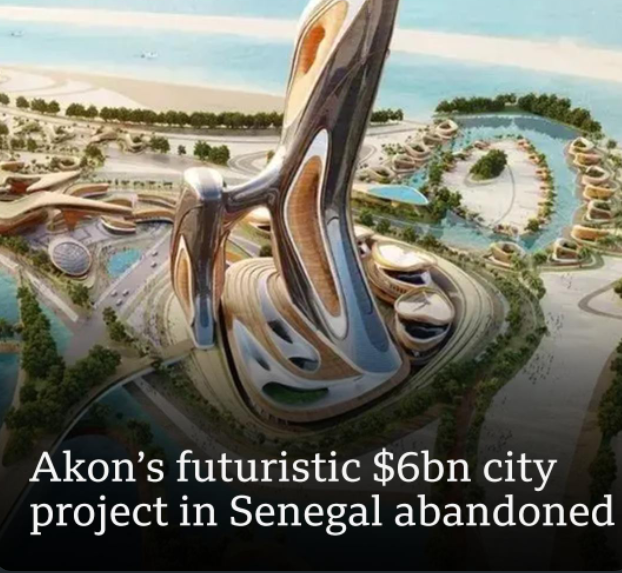
“Akon City Project No Longer Exists, We’re Working on Something More Realistic” – Senegal Official.
Plans for a futuristic $6 billion city in Senegal, envisioned by Senegalese-American singer Akon, have been officially abandoned, with authorities now collaborating with the artist on a more feasible development. Serigne Mamadou Mboup, head of Senegal’s tourism development body, Sapco, confirmed the decision, stating, “The Akon City project no longer exists. Fortunately, an agreement has been reached between Sapco and the entrepreneur Alioune Badara Thiam [Akon]. What he’s preparing with us is a realistic project, which Sapco will fully support.”
Announced in 2018, Akon City was pitched as a high-tech, eco-friendly metropolis on 800 hectares near Mbodiène, 100 km south of Dakar. Inspired by Marvel’s fictional Wakanda from Black Panther, the city was to feature curvaceous skyscrapers, a hospital, shopping mall, university, and solar-powered infrastructure, all running on Akon’s cryptocurrency, Akoin. The ambitious $6 billion (£4.3 billion) project aimed to transform Senegal into a hub for innovation and tourism, with phase one—including a hospital, school, and police station—slated for completion by 2023.

However, nearly seven years later, the site remains largely undeveloped, with only an unfinished welcome centre standing amid empty fields. Funding shortfalls, mismanagement, and legal hurdles stalled progress. Akon admitted to mismanaging the project, particularly the Akoin cryptocurrency, which plummeted from $0.15 to $0.003 by 2024, stating, “It wasn’t being managed properly – I take full responsibility for that.” Senegal’s Central Bank of West African States, which regulates the CFA franc, also opposed the use of cryptocurrency as legal tender, further complicating the project.
Local residents, who anticipated jobs and economic growth, expressed disappointment. “We were promised development, but nothing has changed,” one Mbodiène villager told the BBC. The Senegalese government issued an ultimatum in 2024, demanding progress or the return of the allocated land. With no significant construction, authorities have repossessed most of the 136 acres, leaving Akon with just 8 hectares.
The new plan, backed by Sapco, shifts focus to a $1.2 billion tourism-driven resort project, featuring hotels, apartments, a marina, and a promenade. Expected to create 15,000 jobs in its first phase, the development aligns with Senegal’s preparations for the 2026 Youth Olympic Games, which are set to boost tourism. Mayor Alpha Samb, speaking at a recent ceremony, expressed hope that the resort would become “a model for success in Senegal, a hub for tourism and economic opportunity.”
Akon’s scaled-back role in the project marks a retreat from his original vision but retains his involvement in Senegal’s development. The collapse of Akon City highlights the challenges of celebrity-led megaprojects, with critics noting the lack of a practical roadmap. Posts on X reflect mixed sentiments, with some users lamenting the loss of a “Wakanda-inspired” dream, while others welcome the shift to a more achievable plan. As Senegal moves forward, the focus is on delivering tangible benefits to communities still awaiting the promised transformation.
