


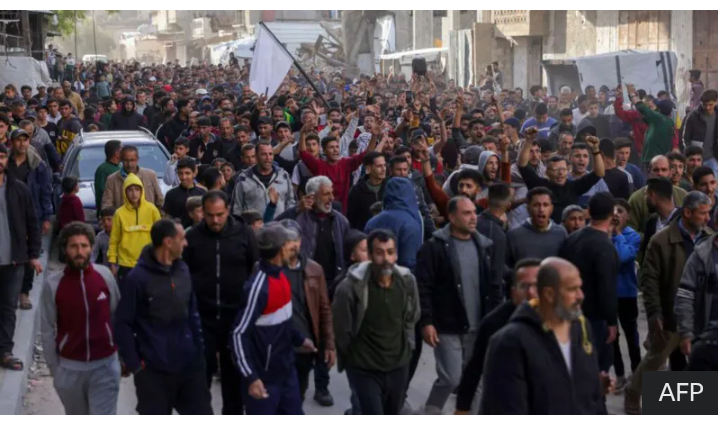
Arab Nations Call for Hamas To Disband And Relinquish Gaza In Historic Move.
In a landmark shift, Qatar, Saudi Arabia, and Egypt have joined international calls for Hamas to disarm and surrender control of Gaza, marking the first time these key Arab powers have publicly condemned the group and demanded its exclusion from Palestinian governance. The unprecedented declaration, issued on 29 July 2025 at a United Nations conference in New York, has been hailed as “historic” by France’s Foreign Minister Jean-Noel Barrot, signalling a potential turning point in efforts to resolve the ongoing conflict in the region.

The joint statement, backed by 17 countries, including Britain, France, and Canada, alongside the entire 22-member Arab League and the European Union, condemned Hamas’s deadly attack on Israel on 7 October 2023, which killed approximately 1,200 people and saw 251 taken hostage. The declaration demands that Hamas release all remaining hostages, agree to an immediate ceasefire, and hand over its weapons to the Palestinian Authority (PA) under international supervision. This move aligns with the broader objective of establishing a sovereign and independent Palestinian state, with the PA assuming control of both Gaza and the West Bank as part of a two-state solution.
The conference, co-chaired by Saudi Arabia and France, aimed to revive the long-stalled two-state solution to the Israeli-Palestinian conflict. The declaration also called for the deployment of a temporary international stabilisation mission to Gaza, under UN auspices and upon invitation by the PA, to ensure stability post-conflict. It urged Israeli Prime Minister Benjamin Netanyahu to commit publicly to a two-state solution, a proposal he has consistently rejected on security and nationalistic grounds. Notably, neither Israel nor the United States attended the conference or signed the declaration, with the US labelling the meeting “unproductive and ill-timed.”
This bold stance by Arab nations follows mounting regional frustration with the humanitarian crisis in Gaza, where over 60,000 Palestinians have been killed, according to local health authorities, and infrastructure has been devastated since the war began. The statement condemned Israel’s attacks on civilians and restrictions on humanitarian aid, which have exacerbated the crisis. Social media posts on X reflect a mix of sentiments, with some praising the Arab League’s call as a step toward peace, while others question Hamas’s willingness to comply, citing internal divisions within the group.
French Foreign Minister Barrot underscored the significance of the declaration, noting that it represents the first time Arab states have explicitly condemned Hamas’s actions on 7 October and expressed a desire to normalise relations with Israel in the future. The Hostages and Missing Families Forum welcomed the move, stating that Hamas’s rule in Gaza must end to prevent further violations of international law.
As ceasefire negotiations mediated by Qatar, Egypt, and the US remain deadlocked, the declaration signals a growing consensus among Arab nations that Hamas’s control of Gaza is an obstacle to peace. Earlier reports suggest Hamas may consider disarming as part of a ceasefire deal, though hardliners within the group are likely to resist. With the international community pushing for a political resolution, this unified stance by Arab powers could reshape the path toward a lasting peace in the region.
