


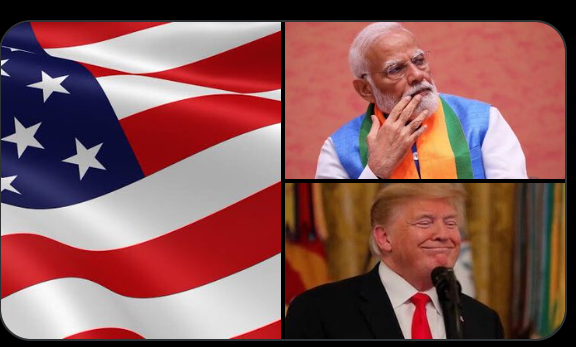
US President Trump Announces 25% Tariff On Indian Imports Amid Ongoing Trade Talks.
Washington, DC – US President Donald Trump has declared that India will face a 25% tariff on its exports to the United States, citing the country’s high tariffs on American goods as a key concern. The announcement, made on Tuesday, 29 July 2025, comes just days before a self-imposed 1 August deadline for finalising a trade agreement between the two nations. Speaking to reporters aboard Air Force One, Trump acknowledged India as a “good friend” but expressed frustration over what he described as India’s excessive tariffs, stating, “India has charged basically more tariffs than almost any other country.”
The proposed tariffs are part of Trump’s broader “reciprocal tariff” policy, aimed at addressing trade imbalances with key trading partners. The US trade deficit with India has doubled over the past decade, reaching approximately $46 billion in 2024, with total bilateral trade in goods amounting to $129 billion. Trump has repeatedly described the trade relationship with India as “very tough,” criticising not only high tariffs but also non-tariff barriers, such as India’s taxes on digital services and stringent regulations on foreign imports.

US Trade Representative Jamieson Greer indicated on Monday that negotiations with India remain ongoing but require further discussion to reach a resolution. “India has expressed strong interest in opening portions of their market, and we are willing to continue talking to them,” Greer told CNBC. Despite optimism from India’s commerce minister last week about the prospect of a deal before the deadline, both sides have yet to resolve key sticking points, which remain undisclosed.
The announcement follows months of back-and-forth negotiations. In May, Trump claimed India had agreed to eliminate tariffs on US exports, a statement swiftly rebutted by India’s Foreign Minister S. Jaishankar, who called the assertion “premature” and described the talks as “complicated” and “intricate.” Indian officials remain hopeful, with one government source suggesting mid-August discussions in Delhi could yield progress, adding that any tariffs imposed might be a temporary measure.
India’s high tariffs, which average 17% compared to the US’s 3.3%, have long been a point of contention. Specific examples include India’s 70% duty on passenger vehicles and 50% on apples, contrasting sharply with lower US tariffs on similar goods. The Trump administration has also highlighted India’s restrictive import regulations, including what it calls “uniquely burdensome” testing requirements, as barriers to fair trade.
While Trump praised India’s role in regional stability, referencing a claim that he helped broker a ceasefire with Pakistan, he remained firm on the need for reciprocity in trade. The proposed 25% tariff, if implemented, would mark a significant escalation from the 10% baseline tariff introduced in April 2025, which was temporarily paused to allow for negotiations.
Indian exporters, particularly in pharmaceuticals, auto parts, and gemstones, are bracing for potential impacts, though some analysts suggest India’s diversified export markets and low reliance on US demand—accounting for just 2.2% of its GDP—could mitigate the economic fallout. Nonetheless, the threat of tariffs has raised concerns about rising costs for American consumers, with global firms like Adidas already warning of price increases due to similar measures.
As the 1 August deadline approaches, both nations face pressure to finalise a deal to avoid the tariffs. With India seen as a critical partner in countering China’s influence, the outcome of these talks carries significant geopolitical and economic weight.
