


Yulia Svyrydenko Appointed Ukraine’s New Prime Minister In Historic Wartime Reshuffle.
Ukraine’s parliament, the Verkhovna Rada, has appointed Yulia Svyrydenko as the nation’s new Prime Minister, marking a significant milestone as she becomes only the second woman to hold the position. The decision, backed by 262 MPs on July 17, 2025, follows President Volodymyr Zelenskyy’s nomination during a sweeping government overhaul, the most substantial since Russia’s full-scale invasion in February 2022. Svyrydenko replaces Denys Shmyhal, who served for over five years and is expected to transition to the role of Defence Minister.
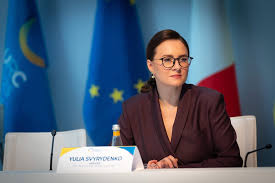
Svyrydenko, a 39-year-old economist, has been a key figure in Ukraine’s wartime economic strategy since her appointment as First Deputy Prime Minister and Minister of Economic Development and Trade in November 2021. Her rise to prominence was cemented earlier this year when she brokered a critical minerals deal with the United States, signed on April 30, 2025, with US Treasury Secretary Scott Bessent. The agreement, establishing the United States-Ukraine Reinvestment Fund, grants the US preferential access to Ukraine’s mineral resources while creating a reconstruction investment fund with shared profits, a move that bolstered ties with the Trump administration. Her leadership at the 4th Ukraine Recovery Conference in Rome, securing €11 billion in economic pledges, further underscored her international stature.

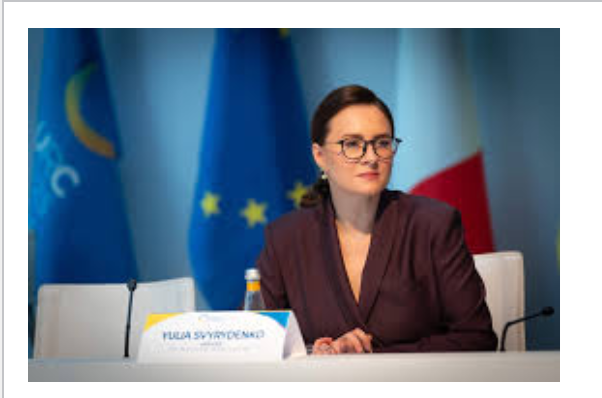
Born in Chernihiv in 1985, Svyrydenko graduated with honours from Kyiv National University of Trade and Economics, earning a master’s degree in antimonopoly management. Her career began in 2008 as an economist at a Ukrainian-Andorran real estate firm, followed by a stint as Chernihiv’s trade representative in Wuxi, China, where she attracted significant foreign investment. She entered public service in 2015, rising to Acting Governor of Chernihiv Oblast in 2018 and later serving as Deputy Head of the President’s Office in 2020. Her extensive experience in economic policy and investor relations has positioned her as a steady hand to navigate Ukraine’s challenges.
In her first address as Prime Minister, Svyrydenko outlined ambitious priorities, pledging to enhance domestic weapons production to meet 50% of Ukraine’s battlefield needs within six months, up from 40%. She also committed to a full audit of public finances to achieve “real savings,” accelerate privatisations, and support entrepreneurs through deregulation. “Our government is setting a course for self-sufficiency: military, economic, and social,” she declared on social media. “My goal is tangible results that every Ukrainian will feel.”
The appointment, supported by Zelenskyy’s Servant of the People party and other parliamentary factions, faced criticism from opposition groups. The European Solidarity faction voted unanimously against her, while the Holos party’s Yaroslav Zheleznyak warned that the new government might lack independence due to Zelenskyy’s wartime powers. Posts on X have also stirred debate, with some questioning the influence of pro-Russian factions in her appointment, though these claims remain unverified and contentious.
Svyrydenko assumes office at a critical juncture, with Ukraine facing a $19 billion budget deficit and intensified Russian offensives. Her agenda includes strengthening economic ties with allies, optimising the state apparatus, and bolstering military capabilities. European Commission President Ursula von der Leyen congratulated her, affirming support for Ukraine’s recovery and EU aspirations. As Svyrydenko steps into this historic role, her leadership will be pivotal in steering Ukraine through its ongoing war and economic recovery.
