


Macron And Putin Hold First Talks In Nearly Three Years, Finding Common Ground On Iran But Clashing On Ukraine.
French President Emmanuel Macron and Russian President Vladimir Putin spoke by telephone on Tuesday, marking their first direct conversation in over two and a half years. The two-hour discussion, described as substantial by both the Élysée Palace and the Kremlin, focused on Iran’s nuclear programme and the ongoing war in Ukraine, revealing areas of agreement as well as persistent divisions.
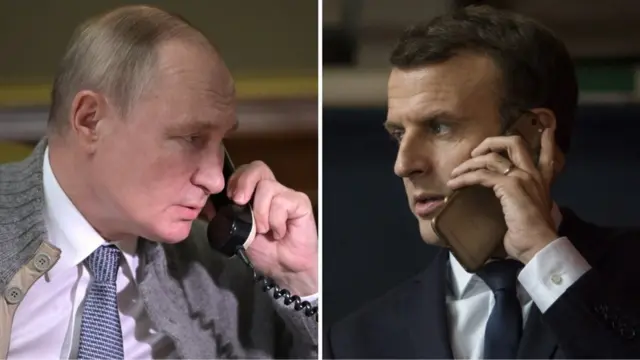
On the issue of Iran, the two leaders found a degree of alignment, emphasising their shared responsibility as permanent members of the UN Security Council to maintain peace and uphold the nuclear non-proliferation regime. Macron urged Iran to comply fully with its obligations under the Nuclear Non-Proliferation Treaty (NPT) and to cooperate with the International Atomic Energy Agency (IAEA). Putin, meanwhile, stressed Iran’s right to develop a peaceful nuclear programme, provided it adheres to international commitments. Both leaders agreed to coordinate further efforts and continue discussions to address tensions in the Middle East, particularly following recent US strikes on Iranian nuclear facilities and the Iran-Israel conflict.

However, the conversation exposed stark differences over the war in Ukraine. Macron reaffirmed France’s unwavering support for Ukraine’s sovereignty and territorial integrity, calling for an immediate ceasefire and the start of negotiations to achieve a lasting resolution. He informed Ukrainian President Volodymyr Zelenskyy of the call both before and after to ensure transparency. In contrast, Putin reiterated Moscow’s position that the conflict stems from Western policies, accusing NATO and Western nations of ignoring Russia’s security concerns and turning Ukraine into an “anti-Russian bridgehead.” He insisted that any peace agreement must be “comprehensive and long-term,” addressing what he called the “root causes” of the crisis and reflecting “new territorial realities,” a reference to Russia’s annexation of Ukrainian territories.
The call, initiated by Macron, was seen by some analysts as an attempt to reassert France’s role in global diplomacy, particularly on the Iranian nuclear issue, where the European Union seeks to regain influence. The French presidency noted that both leaders agreed to maintain contact on both Ukraine and Iran, signalling a potential thaw in Franco-Russian communication despite deep-seated disagreements.
This rare exchange follows a period of strained relations, with Macron and Putin last speaking in September 2022, months after Russia’s invasion of Ukraine. While the leaders maintained regular contact in the early stages of the conflict, criticism from some European allies had led France to scale back direct engagement with Moscow. Tuesday’s conversation suggests a cautious reopening of dialogue, though significant hurdles remain in bridging the gap between Paris and Moscow on the Ukrainian crisis.
