


Football Laws Updated For 2025/26 Season: Key Changes Announced By IFAB.
The International Football Association Board (IFAB) has unveiled a series of amendments to the Laws of the Game, set to take effect for the 2025/26 season. These changes, aimed at enhancing clarity, fairness, and the flow of matches, were confirmed in an official statement from IFAB (@TheIFAB). Here’s a rundown of the key updates:
1. Team Captains Take Charge of Referee Communication

Under an amendment to Law 3 (Players), only the team captain will be permitted to speak to the referee during matches. This rule aims to reduce confrontations and streamline communication, ensuring that only one voice represents the team in discussions with officials.
2. Goalkeeper Countdown Signal Introduced
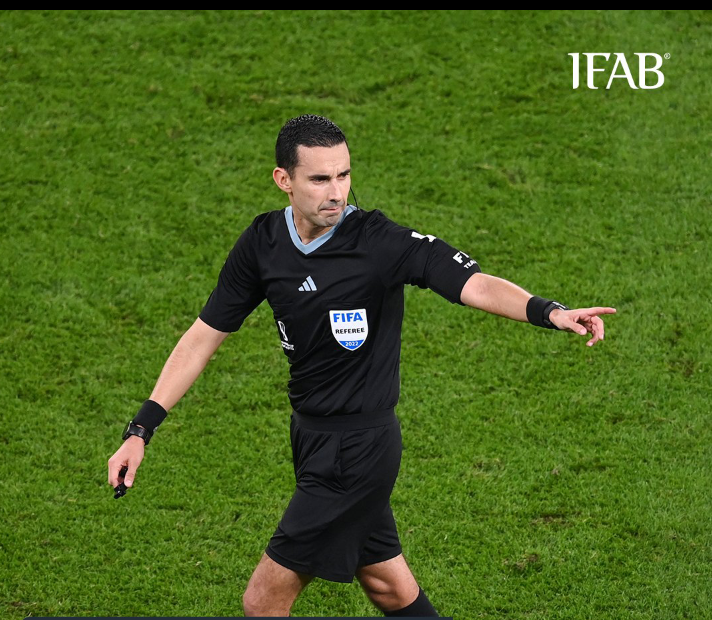
Law 5 (Referees) now includes a new countdown signal for goalkeepers. Referees will visibly count down the final five seconds of the eight-second limit allowed for goalkeepers to hold the ball, improving timekeeping transparency.
3. Revised Dropped Ball Procedures
Changes to Law 8 (Dropped Ball) clarify what happens when play is stopped. If the ball is inside or was last touched inside the penalty area, it will be dropped to the defending team’s goalkeeper. Outside the penalty area, the ball is dropped to a player from the team that would have had possession, or, if unclear, to a player from the team that last touched it, at the point where play was halted.
4. Penalties for Interfering with Play
An update to Law 9 (Ball Position) addresses actions by coaches, substitutes, or players temporarily off the pitch. If they touch a ball still in play but clearly heading out, with the intent to speed up play, an indirect free kick will be awarded to the opposing team. No disciplinary action will be taken unless the offence is repeated, such as a coach repeatedly leaving the technical area.
5. Offside Rule Clarified
Law 11 (Offside) has been refined to specify that the first point of contact with the ball determines an offside call. However, when the goalkeeper handles the ball, the last point of contact will be used as the reference for greater accuracy.
6. Stricter Goalkeeper Time-Wasting Rules
Amendments to Law 12 (Fouls and Misconduct) introduce a corner kick for the opposing team if a goalkeeper holds the ball for more than eight seconds. No caution will be issued unless the offence is repeated. Additionally, indirect free kicks will be awarded for other goalkeeper infractions, such as controlling the ball for more than six seconds without releasing it or handling it after an intentional pass or throw-in from a teammate (unless attempting to play it with their foot).
7. Goal Kick Clarification
Law 16 (Goal Kick) now clearly states that a goal kick is awarded when the ball fully crosses the goal line without a goal being scored and was last touched by an attacking player. This aligns with related laws for consistency.
8. Corner Kick Updates
Similarly, Law 17 (Corner Kick) confirms that a corner kick is awarded when the ball crosses the goal line after being touched by a defending player, without a goal. The kick is taken from the nearest corner or, in cases of goalkeeper penalties (e.g., exceeding eight seconds), from the goalkeeper’s position.
9. Enhanced VAR Transparency
The Video Assistant Referee (VAR) protocol has been updated to require referees to display the “TV screen” signal and announce their final decision after a review. Competitions may also adopt a system allowing referees to publicly explain decisions post-VAR review, following FIFA guidelines and the VAR Manual.
These changes reflect IFAB’s commitment to improving the game’s fairness, clarity, and engagement for players, officials, and fans alike. For more details, visit the IFAB’s official website or follow.
