


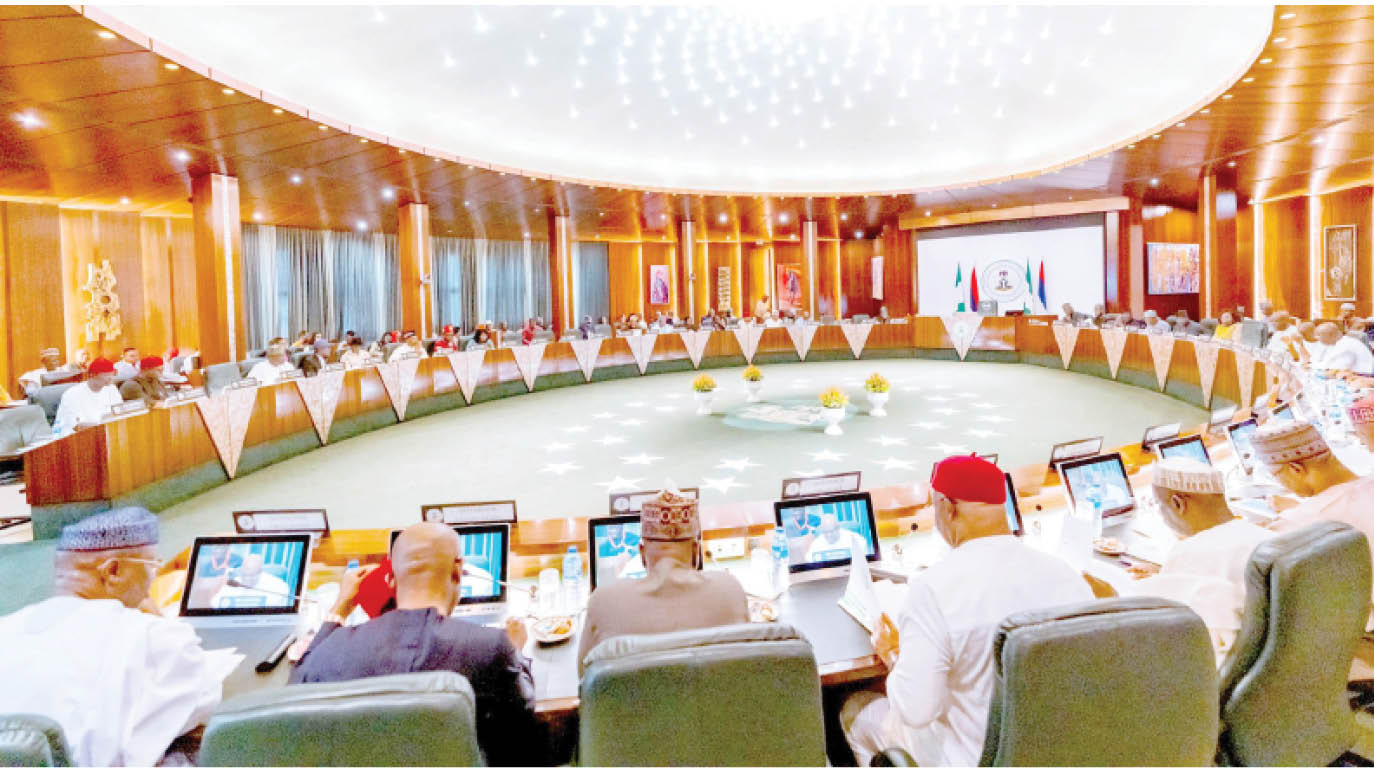
NEC Endorses Bold Economic Plans While Deferring Decision On State Police.
The National Economic Council (NEC) has once again postponed discussions on the creation of state police, despite rising insecurity in several regions of Nigeria. However, the Council approved a series of ambitious economic reforms aimed at revitalising the nation’s economy and tackling the root causes of insecurity.
Among the key decisions taken at Thursday’s sitting was the approval for the establishment of a Cotton, Textile and Garment Development Board, as well as fresh strategies for agribusiness expansion and livestock transformation. These initiatives are projected to generate up to $90 billion in economic value by 2035, creating jobs and addressing the underlying factors driving conflict, particularly in rural areas.

Kaduna State Governor, Uba Sani, expressed confidence that state police would offer a sustainable solution to Nigeria’s deepening security challenges. However, the matter was deferred once again, with Bayelsa State Governor, Douye Diri, noting that lengthy presentations on other national issues prevented the Council from fully engaging with the topic.
Although the issue was on the agenda, Diri explained that discussions were postponed but would be addressed in full at the next Council meeting. He added that the Ministry of Livestock Development had presented an update on its ranching strategy as part of the broader push for modernised livestock management and peacebuilding.
The need for urgent reforms comes amid persistent violence linked to herdsmen in states like Plateau, Benue, and Zamfara. At least 22 states across the country have been affected by such attacks, many in the North Central region. In response, President **Bola Tinubu** reiterated the federal government’s commitment to promoting ranching and has urged governors to allocate land for modern cattle rearing.
In parallel with the economic measures, NEC also approved the establishment of a national office for the Green Imperative Project (GIP) in Abuja, along with six regional offices across Nigeria. This move is aimed at improving agricultural productivity and reducing the economic impact of outdated animal husbandry practices.
Ekiti State Governor, Biodun Oyebanji, provided an update on the National Reserve Development Account, which currently stands at over ₦72.8 billion as of April 2025.
On the sidelines of the Nigerian Governors’ Forum (NGF) meeting, Governor Sani noted that constitutional limitations hinder governors from taking more decisive action on security. However, he expressed hope that the issue of state police would soon be resolved.
“The creation of state police would go a long way in addressing insecurity, particularly at the sub-national level,” he said.
Meanwhile, the Chief of Defence Staff (CDS), General Christopher Musa, presented a proposal for a technology-driven security initiative to strengthen both national and state-level response systems. Following a two-hour closed-door meeting with the NGF, the governors announced plans to adopt advanced surveillance and crisis management tools, and to recruit more personnel to boost the nation’s security forces.
A communiqué signed by Kwara State Governor Abdulrahman AbdulRazaq and read by Imo State Governor, Hope Uzodimma, confirmed that the forum had set up a committee to explore these solutions.
Governors expressed strong support for the project’s goals, underscoring the urgent need to harness technology to counter Nigeria’s evolving security threats.
