


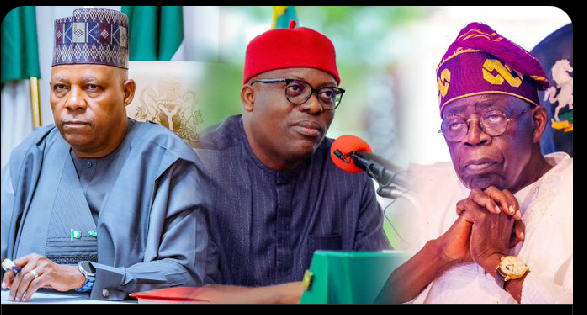
Vice President Shettima Challenges Tinubu Over Fubara’s Suspension.
Vice President Kashim Shettima publicly contradicted President Bola Tinubu’s decision to suspend Rivers State Governor Siminalayi Fubara, asserting that the president lacks the constitutional authority to remove an elected governor. Speaking at a book launch in Abuja, Shettima declared that “no president has the power to remove an elected councillor, let alone a governor,” igniting fresh debate over the legality of Tinubu’s actions.
Tinubu had announced Fubara’s six-month suspension, alongside his deputy, Ngozi Odu, and the Rivers State House of Assembly, in a nationwide broadcast on 18 March 2025. Citing prolonged political turmoil and governance paralysis in Rivers State, Tinubu declared a state of emergency, appointing retired Vice Admiral Ibok-Ette Ibas as the state’s administrator. The move sparked widespread criticism, with legal experts and opposition figures labelling it unconstitutional.


Shettima’s remarks, delivered with characteristic candour, have intensified speculation about tensions within the presidency. Political analysts suggest the vice president’s statement indirectly questions the advice of Attorney-General Lateef Fagbemi, who defended Tinubu’s decision, claiming the president could sack any governor. Fagbemi’s stance, however, lacks clear constitutional backing, as Section 305 of the Nigerian Constitution allows emergency declarations to restore order but does not explicitly permit the removal of elected officials.
The controversy stems from a bitter feud between Fubara and his predecessor, Nyesom Wike, now Minister of the Federal Capital Territory. Wike accused Fubara of dismantling the political structure that secured his governorship, alleging disobedience to directives from Tinubu and Shettima to resolve the crisis. The rift has fuelled political instability in Rivers State, prompting Tinubu’s intervention.
Legal voices have echoed Shettima’s position. Human rights lawyer Morakinyo Olasupo argued that a president cannot suspend a democratically elected governor without impeachment by the state House of Assembly and judicial processes. Veteran actor and politician Kenneth Okonkwo also condemned the suspension, citing former President Goodluck Jonathan’s handling of Boko Haram-related emergencies in Borno, Yobe, and Adamawa, where governors, including then-Governor Shettima, remained in office.
Shettima’s public rebuke has sparked varied reactions. Posts on X reflect a mix of support and intrigue, with some viewing it as a bold stand against overreach, while others see it as a sign of deeper cracks in the Tinubu-Shettima partnership. One user noted, “Sheti is ready to fight,” suggesting the vice president’s readiness to challenge the status quo.
The Rivers crisis remains unresolved, with Fubara reportedly meeting Tinubu in London last month to discuss restoring democratic governance. Insiders hint at potential reconciliation talks involving Wike and state lawmakers, but the path forward is uncertain. For now, Shettima’s statement has reframed the debate, spotlighting the delicate balance of power and constitutional limits in Nigeria’s volatile political landscape.