


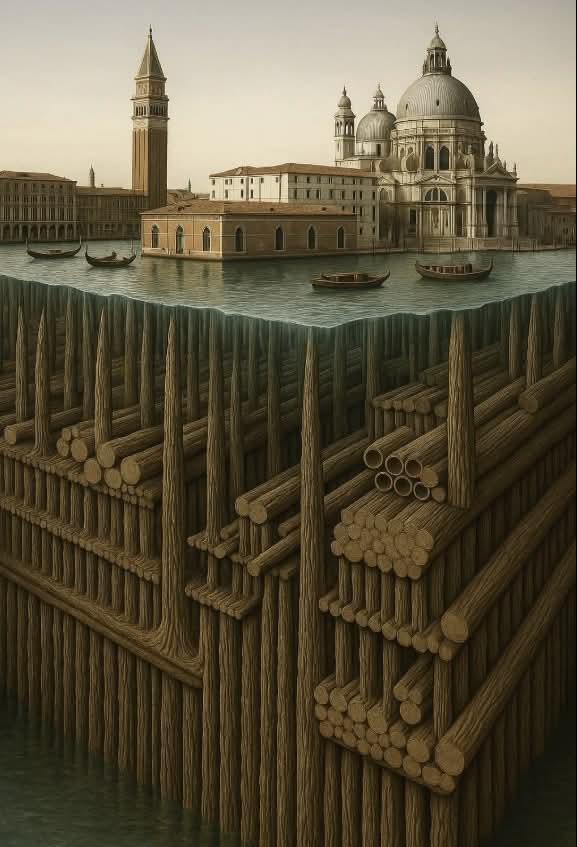
Venice: The Floating City Built On A Forest Of Wooden Piles.
For over 1,500 years, Venice has captivated the world as a city that defies the odds, rising improbably from the waters of the Venetian lagoon. Unlike cities anchored on bedrock or concrete, this UNESCO World Heritage Site rests on millions of wooden piles driven deep into the seafloor—a feat of engineering that continues to astonish historians and architects alike.
Since its founding in 421 A.D., Venice has stood as a testament to human ingenuity. Fleeing barbarian invasions that ravaged mainland Italy, early settlers sought refuge in the lagoon’s muddy marshes. The water became their greatest ally, forming a natural barrier that deterred enemies. But building a city on such unstable ground required an extraordinary solution: a foundation of timber.


The wood of choice was alder, a species abundant in the region and uniquely suited to the lagoon’s conditions. When submerged in the oxygen-poor, salty water and encased in clay, alder wood resists rot and hardens over time, becoming almost as durable as stone. This process, often likened to petrification, has allowed Venice’s wooden foundations to endure for centuries.
The scale of this endeavour is staggering. St. Mark’s Campanile, the iconic bell tower in Piazza San Marco, is supported by approximately 100,000 wooden piles. The grand Basilica di Santa Maria della Salute, a Baroque masterpiece, required over a million. Each pile was painstakingly hammered by hand, spaced roughly half a metre apart and driven up to three metres into the seabed. This intricate lattice of timber continues to bear the weight of Venice’s palaces, churches, and bridges.
“Venice is a marvel that challenges conventional engineering,” says Dr. Giulia Rossi, a historian at the University of Venice Ca’ Foscari. “The use of wood in such an environment seems counterintuitive, yet it has proven remarkably effective. The lagoon’s unique conditions have preserved these foundations for centuries.”
The city’s origins as a refuge shaped its destiny. The lagoon’s isolation not only protected its inhabitants but also fostered a thriving maritime republic that became a global hub of trade and culture. Today, Venice’s canals and historic architecture draw millions of visitors annually, all supported by the same wooden piles laid down by its founders.
However, Venice faces modern challenges, including rising sea levels and subsidence, which threaten its delicate balance. Efforts to preserve the city, such as the MOSE flood barrier system, aim to protect this timeless wonder for future generations.
As Venice continues to defy both time and nature, its story serves as a reminder of human resilience and creativity. From a desperate refuge in a marshy lagoon to one of the world’s most beloved cities, Venice remains a living monument to the power of innovation.