

US Announces Ambitious Plan To Build Nuclear Reactor On Moon By 2030.
The United States has unveiled plans to construct a nuclear reactor on the Moon by 2030, a bold move aimed at securing its position in the intensifying global space race. Sean Duffy, the interim NASA administrator and US Transportation Secretary, is set to announce an accelerated timeline for the project, which seeks to establish a reliable power source for future lunar missions, according to internal NASA documents reported by US media.
The directive, issued by Duffy, instructs NASA to solicit industry proposals within 60 days for a 100-kilowatt nuclear fission reactor, a significant upgrade from earlier plans for a 40-kilowatt system targeted for the early 2030s. The reactor is intended to support a sustained human presence on the lunar surface, powering habitats, scientific experiments, and potential industrial operations such as mining. Unlike solar panels, which struggle during the Moon’s 14-day nights, a nuclear reactor would provide continuous energy, critical for long-term lunar exploration and eventual Mars missions.


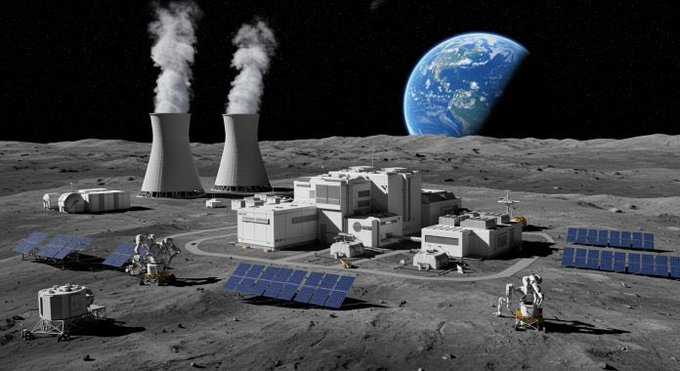

The announcement comes amid growing concerns over China and Russia’s joint plans to deploy a lunar reactor by the mid-2030s as part of their International Lunar Research Station. NASA’s directive warns that the first nation to establish a reactor could claim “keep-out zones,” potentially restricting US access to key lunar regions, particularly the resource-rich south pole. “If we are to have a habitable system on the Moon, we must bring power,” a NASA official stated, likening the technology to small reactors used in submarines and aircraft carriers.
Duffy’s initiative, one of his first major actions since being appointed interim NASA chief in July, aligns with the Trump administration’s focus on crewed spaceflight and US dominance in space. The plan also includes a separate directive to replace the ageing International Space Station by 2030 with commercially operated stations, with contracts to be awarded to at least two private firms within six months. Companies such as Axiom Space, Blue Origin, and Vast are among the contenders.
However, the ambitious timeline faces challenges. NASA is grappling with significant budget cuts, with a proposed 24% reduction for 2026, prompting criticism from agency employees. A recent letter, signed by over 150 NASA staff, warned that such cuts could jeopard the agency’s ability to deliver critical projects. Additionally, the Artemis programme, which aims to return humans to the Moon by 2027, has faced delays due to unproven technologies like SpaceX’s Starship lunar lander. Experts, including Professor Lionel Wilson of Lancaster University, argue that the 2030 deadline is technically feasible but requires substantial funding and multiple successful Artemis launches to build the necessary infrastructure.
Safety concerns also loom large. Launching radioactive material into space requires stringent protocols, though NASA insists the reactor’s fuel will remain inactive until it reaches the lunar surface. Dr Simeon Barber, a planetary science specialist at the Open University, noted that while nuclear power is essential for a lunar base, the lack of confirmed plans for a permanent habitat raises questions about the project’s coherence. “If you’ve got nuclear power but no way to get people and equipment there, it’s not much use,” he cautioned.
The push for a lunar reactor reflects broader geopolitical tensions, with nations like China, Russia, India, and Japan vying for lunar dominance. Posts on X highlight enthusiasm for the project, with some users describing it as a step towards “interplanetary autonomy” and a “power core for an off-world civilisation.” However, others question the feasibility amidst NASA’s funding woes and political upheaval, including the recent withdrawal of Jared Isaacman’s nomination as NASA chief.
As the US races to outpace its rivals, the nuclear reactor project underscores the strategic importance of the Moon in future exploration and economic prospects. Whether NASA can overcome technical, financial, and logistical hurdles to meet the 2030 deadline remains a critical question for the next chapter of human spaceflight.