Despite its membership in the US-dominated NATO alliance, Turkey has not joined Western sanctions against Russia for its invasion of Ukraine.
Instead, Turkish President Recep Tayyip Erdoğan has positioned himself as a mediator between Russia and Ukraine, playing a key role in negotiations over grain shipments from Black Sea ports and the recent prisoner exchange between Moscow and Washington.
Speaking in Istanbul, Erdoğan emphasized Turkey’s strategic need to maintain balanced relations with both Eastern and Western powers. “Turkey can become a strong, prosperous, prestigious, and effective country if it improves its relations with the East and the West simultaneously,” he stated.
He also insisted that Turkey does not need to choose between the EU and other international partnerships, advocating for a “win-win” approach.
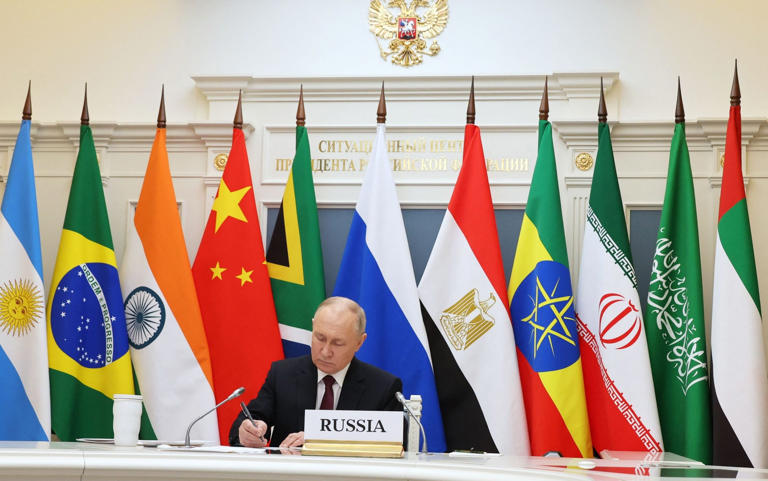
BRICS, which serves as a counterbalance to the US-led G7 group of wealthy nations, recently expanded its membership to include the United Arab Emirates, Ethiopia, and Egypt. Turkey’s application to join will be discussed at a BRICS meeting in Russia this October.
The Kremlin has already expressed a welcoming stance towards Turkey’s interest in joining, though this move is expected to create tension within NATO.
Sinan Ülgen, a former diplomat and head of the Istanbul-based think tank EDAM, described Turkey’s strategy as an effort to strengthen ties with non-Western powers at a time when US global influence is perceived to be declining.
He noted that the bilateral relationship between Turkey and the US has faced challenges, further motivating Turkey to explore alternative international alliances.