


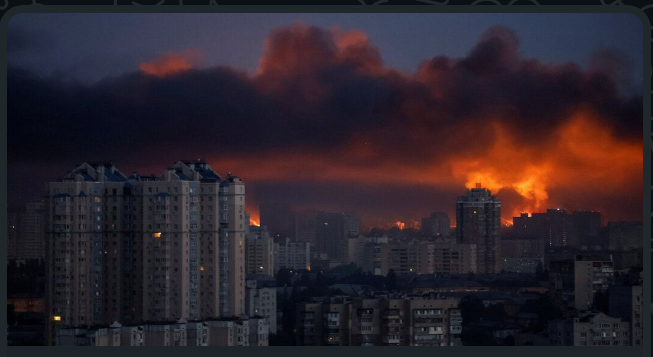
The Latest Development As Israel And Iran Escalate Conflict With Intense Missile Strikes.
The ongoing conflict between Israel and Iran has intensified, with both nations exchanging waves of missile strikes since 13 June 2025, marking a significant escalation in their long-standing tensions. The conflict, now in its seventh day as of 19 June 2025, has caused significant casualties and damage, reshaping the Middle East’s security landscape. Below is a detailed overview of verified developments based on available reports.
Timeline of Key Events


The conflict erupted on 12 June 2025, when Israel launched “Operation Rising Lion,” a series of pre-emptive strikes targeting Iran’s nuclear facilities, military infrastructure, and senior leadership. Israel’s stated goal, as articulated by Prime Minister Benjamin Netanyahu, is to “degrade, destroy, and remove” the threat of Iran’s nuclear programme, which Israel claims was nearing weaponisation. Iran denies these allegations, asserting its nuclear programme is peaceful.
Since then, both nations have engaged in tit-for-tat attacks:
13 June: Israel struck nuclear sites, including the Natanz uranium enrichment facility, causing significant damage to approximately 15,000 centrifuges due to a power cut. Iran responded with ballistic missile and drone strikes on Tel Aviv and Jerusalem.
14–15 June: Iran launched retaliatory missile barrages, hitting central Tel Aviv, including areas near the Israeli Defense Forces (IDF) headquarters. Israel continued strikes on Iranian military targets, killing senior Islamic Revolutionary Guard Corps (IRGC) commanders and nuclear scientists.
16 June: Iranian missiles struck Israel’s largest oil refinery in Haifa Bay, sparking fires, while Israel hit Iran’s state broadcaster and oil facilities. At least 17 people were killed in Israel, and 224 in Iran by this date.
17–18 June: Israel targeted 40 sites in Iran, including centrifuge production facilities in Tehran and Kahraj. Iran imposed a near-total internet blackout, limiting communication.
19 June: Iran’s missiles hit Soroka Medical Center in Be’er Sheva, causing extensive damage, while Israel struck Iran’s Arak heavy water reactor, which the IDF claims was rendered unusable for plutonium production. Explosions were reported in Tel Aviv, Jerusalem, and Tehran.
Casualties and Damage
Israel: At least 24 civilians have been killed since the conflict began, with significant damage in Tel Aviv, Haifa, Petah Tikva, and Be’er Sheva. Iranian missiles, including the advanced Haj Qassem missile, have evaded Israeli air defences, striking residential and strategic sites. The Soroka Hospital attack wounded several people, and 24 buildings in Israel are slated for demolition.
Iran: Over 640 deaths have been reported, including 60 in a single Tehran strike, with 20 children among the casualties. Strikes have targeted nuclear sites (Natanz, Arak, and possibly Fordow), military bases, oil infrastructure, and the state broadcaster. The IRGC’s ability to coordinate responses has been hampered by the loss of top commanders.
Strategic and Diplomatic Developments
Israel’s strikes aim to cripple Iran’s nuclear capabilities and military infrastructure. The IDF claims to have degraded Iran’s missile production and air defences, targeting 12 missile launch sites on 17 June alone. The International Atomic Energy Agency (IAEA) has condemned attacks on nuclear facilities, with Director General Rafael Grossi noting severe damage at Natanz and urging restraint.
Iran has retaliated with continuous missile and drone attacks, with the IRGC vowing “focused and continuous” strikes. Iran’s Foreign Minister Abbas Araghchi accused the U.S. of supporting Israel’s attacks, a claim the U.S. denies. Iran has also urged the U.S., UK, and France to enforce a ceasefire, warning of retaliatory strikes on their regional assets if they intervene.
U.S. involvement remains a contentious issue. President Donald Trump has called for Iran’s “unconditional surrender” and hinted at prior knowledge of Israel’s plans, though he denies direct U.S. involvement. Israeli officials have pressed the U.S. to use its Massive Ordnance Penetrator against Iran’s fortified Fordow facility, but Trump has not committed, with a Situation Room briefing scheduled for 19 June. A U.S. intelligence briefing to senators indicated Iran is not actively building a nuclear weapon, contradicting some Israeli claims.
Regional and International Reactions
The conflict risks broader regional escalation. Iran’s Supreme Leader Ali Khamenei warned of “irreparable consequences” for U.S. intervention, while Shi’ite militias have vowed retribution. The UK, previously involved in redesigning the Arak reactor, is engaging diplomatically, with its foreign secretary meeting U.S. counterparts. A U.S. Senate resolution to limit unauthorised military action against Iran was introduced on 16 June, reflecting concerns about escalation.
Current Situation
As of 19 June 2025, both sides continue to trade strikes, with Israel’s air force conducting fresh raids on Tehran and Iran launching missiles at Gush Dan, Petah Tikva, and Tel Aviv. Public safety restrictions in Israel have been eased, allowing limited gatherings, while Iran has extended flight cancellations and restricted internet access to counter Israeli evacuation warnings. The conflict shows no immediate signs of abating, with both nations sustaining significant losses but maintaining their military postures.
The situation remains fluid, with accurate information limited by ongoing information warfare and internet blackouts in Iran. The international community continues to monitor the conflict closely, fearing a wider regional war.