


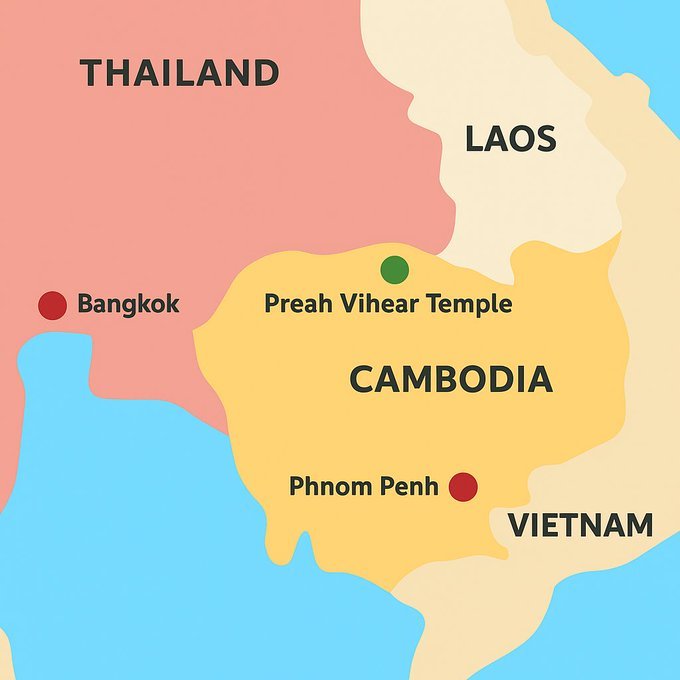
Thailand And Cambodia Agree To Immediate Ceasefire In Border Dispute.
Thailand and Cambodia have reached a landmark agreement for an “immediate and unconditional ceasefire” to halt the deadliest border clashes between the two nations in over a decade. The announcement, made by Malaysian Prime Minister Anwar Ibrahim, follows intense negotiations in Putrajaya, Malaysia, on Monday, 28 July 2025. The ceasefire, effective from midnight local time (17:00 GMT), marks a critical step towards de-escalating a conflict that has claimed at least 38 lives and displaced over 300,000 people.
The talks, hosted by Malaysia as the current chair of the Association of Southeast Asian Nations (ASEAN), brought together Cambodian Prime Minister Hun Manet and Thailand’s acting Prime Minister Phumtham Wechayachai. The leaders met at Anwar’s official residence, joined by representatives from the United States and China, who played significant roles in supporting the mediation process. Anwar described the agreement as “a vital first step towards de-escalation and the restoration of peace and security” in the region.


The conflict, which erupted on Thursday, 24 July, stems from a long-standing border dispute, particularly over the Preah Vihear temple, a UNESCO World Heritage Site awarded to Cambodia by the International Court of Justice in 1962. Tensions flared after a landmine explosion killed five Thai soldiers, prompting heavy artillery exchanges and airstrikes. Both nations accused each other of initiating the violence, which led to significant civilian and military casualties, with Thailand reporting 20 deaths, including 13 civilians, and Cambodia confirming 13 fatalities, eight of them civilians.
During the press conference, Hun Manet expressed optimism, stating, “We had a very good meeting with very good results that we hope will stop the fighting immediately, which has caused many lives lost and displaced many people.” Phumtham echoed this sentiment, affirming Thailand’s commitment to a peaceful resolution while protecting its sovereignty. Both leaders shook hands, symbolising a renewed intent to restore trust and cooperation.
The ceasefire agreement includes plans for an informal meeting of regional military commanders on Tuesday, 29 July, to ensure compliance, followed by a session of defence attachés led by ASEAN. Direct communication channels between the prime ministers, foreign ministers, and defence ministers of both nations will also be reinstated to prevent further escalation. However, analysts caution that sustaining the truce will be challenging due to deep-seated nationalist sentiments and mistrust between the two militaries.
The mediation process received significant international backing. US President Donald Trump, who had urged both nations to cease hostilities, claimed credit for facilitating the talks, stating on social media, “I am pleased to announce that, after the involvement of President Donald J Trump, both countries have reached a ceasefire and peace.” He also instructed his trade team to resume negotiations with Thailand and Cambodia, which had been paused due to the conflict. China, a key economic partner to both nations, sent observers to the talks, reinforcing the global interest in stabilising the region.
Residents along the border, particularly those displaced, welcomed the news. In Thailand’s Surin province, evacuees celebrated at relocation camps, expressing hope of returning home. Phum Sokhorn, a 62-year-old farmer displaced from near the Ta Moan Temple, said, “Staying here is miserable. I urge both sides to resolve this through legal means at the International Court of Justice.”
Despite the optimism, questions remain about the ceasefire’s enforcement and long-term viability. Ou Virak, president of Cambodia’s Future Forum, noted, “A ceasefire can be quickly achieved, but peace is not easy.” The agreement represents a significant diplomatic achievement for ASEAN and Malaysia, but ongoing monitoring and dialogue will be crucial to prevent a resurgence of violence in this historically contentious border region.
The international community, including the United Nations, has called for both nations to honour their commitments and pursue a lasting resolution. As the ceasefire takes effect, the focus now shifts to rebuilding trust and ensuring the safe return of thousands of displaced civilians to their homes.