


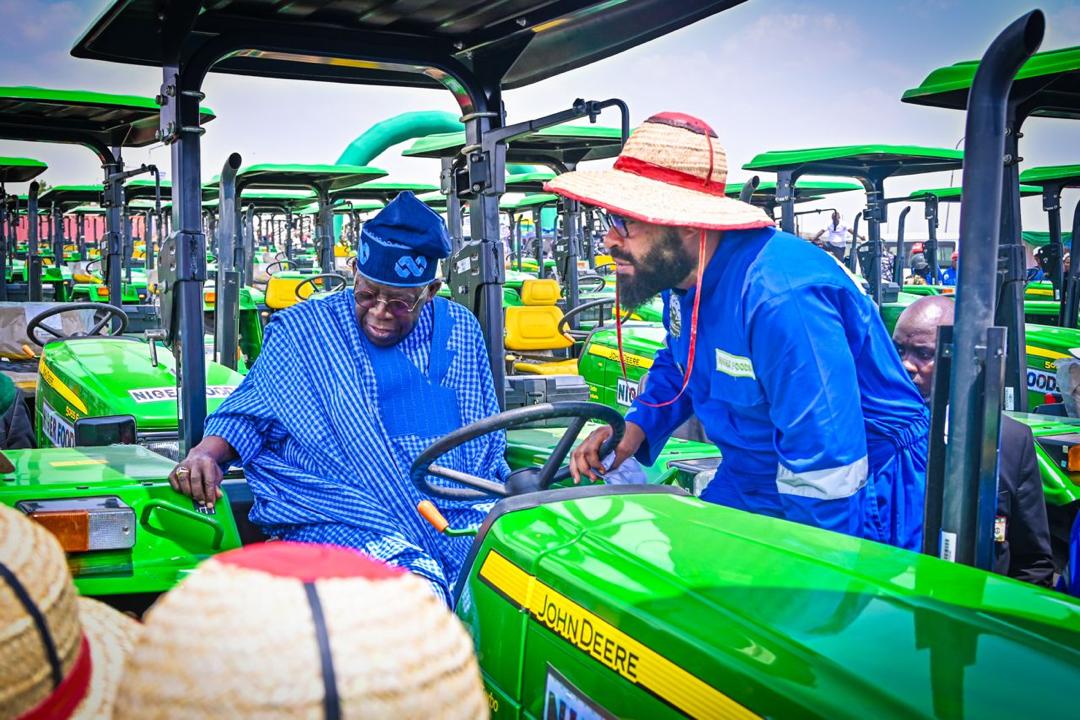
Nigeria’s Agricultural Sector Poised For Growth As FG Bolsters Mechanisation, Says AGCOMS.
Nigeria’s agricultural landscape is on an upward trajectory, driven by the Federal Government’s robust mechanisation initiatives, according to AGCOMS International Trading Limited, the country’s authorised dealer of John Deere equipment. Speaking at the 2025 NAMPO Harvest Day in South Africa, Chijioke Okoli, AGCOMS’s Chief Executive Officer, highlighted the transformative potential of the government’s focus on increasing tractor usage to address the nation’s historically low mechanisation levels.
The four-day NAMPO event, Africa’s largest agricultural trade fair, hosted over 87,000 visitors and 750 exhibitors, providing a global platform for AGCOMS to showcase Nigeria’s agricultural ambitions. Okoli led a 10-member delegation to spotlight the country’s potential to investors, emphasising the Tinubu administration’s commitment to deploying 30,000 tractors over five years, establishing mechanisation hubs, and training operators and technicians. “Despite Nigeria’s current mechanisation challenges, the prospects are bright,” Okoli stated, noting that the government’s policies are a “game-changer” for the sector.


A key highlight was the unveiling of the John Deere 9RX 830 hp tractor, a high-performance machine designed for large-scale farming, which AGCOMS aims to introduce to Nigerian farmers. The company is also constructing Nigeria’s largest agricultural equipment assembly and service hub in Abuja, aligning with the Federal Government’s $1 billion Renewed Hope Mechanisation Programme. This initiative includes a $70 million contract signed in January 2025 with the National Agricultural Development Fund (NADF) to supply 2,000 tractors, 100 combined harvesters, and other equipment, with the first batch expected by March 2025 to support the wet farming season.
The Federal Ministry of Agriculture and Food Security, led by Senator Abubakar Kyari, has prioritised mechanisation to boost food security and reduce reliance on imports. The programme aims to cultivate 25,000 hectares across Nigeria’s six geopolitical zones, with an assembly plant near Nigerian ports to ensure efficient distribution. Kyari emphasised that the initiative targets youth and women, aiming to reduce the drudgery of traditional farming and attract new entrants to agriculture.
Despite these strides, challenges persist. The All Farmers Association of Nigeria (AFAN) noted that promised tractors have yet to be delivered, though the importation process is ongoing. National President Kabir Ibrahim expressed optimism, stating, “It’s a work in progress,” but highlighted gaps in mechanisation, financing, and security that continue to hamper food production. Nigeria’s tractor density remains among the world’s lowest at 0.27 hp/hectare, far below the FAO’s recommended 1.5 hp/hectare.
As Nigeria aims to lead Africa’s march towards sustainable agriculture, the government’s partnership with AGCOMS and global manufacturers like John Deere signals a promising shift towards modernised farming, poised to enhance productivity and secure food security for the nation.