

Morocco Crowned 2025 U-17 AFCON Champions After Thrilling Penalty Shootout Victory Over Mali.
Morocco’s U-17 national football team, the Atlas Cubs, etched their names into African football history by clinching their first-ever TotalEnergies U-17 Africa Cup of Nations (AFCON) title, defeating Mali 4-2 on penalties after a tense 0-0 draw in the final at El Bachir Stadium. The victory, secured in front of a passionate home crowd, marked a historic milestone for Moroccan football and sparked celebrations across the nation.
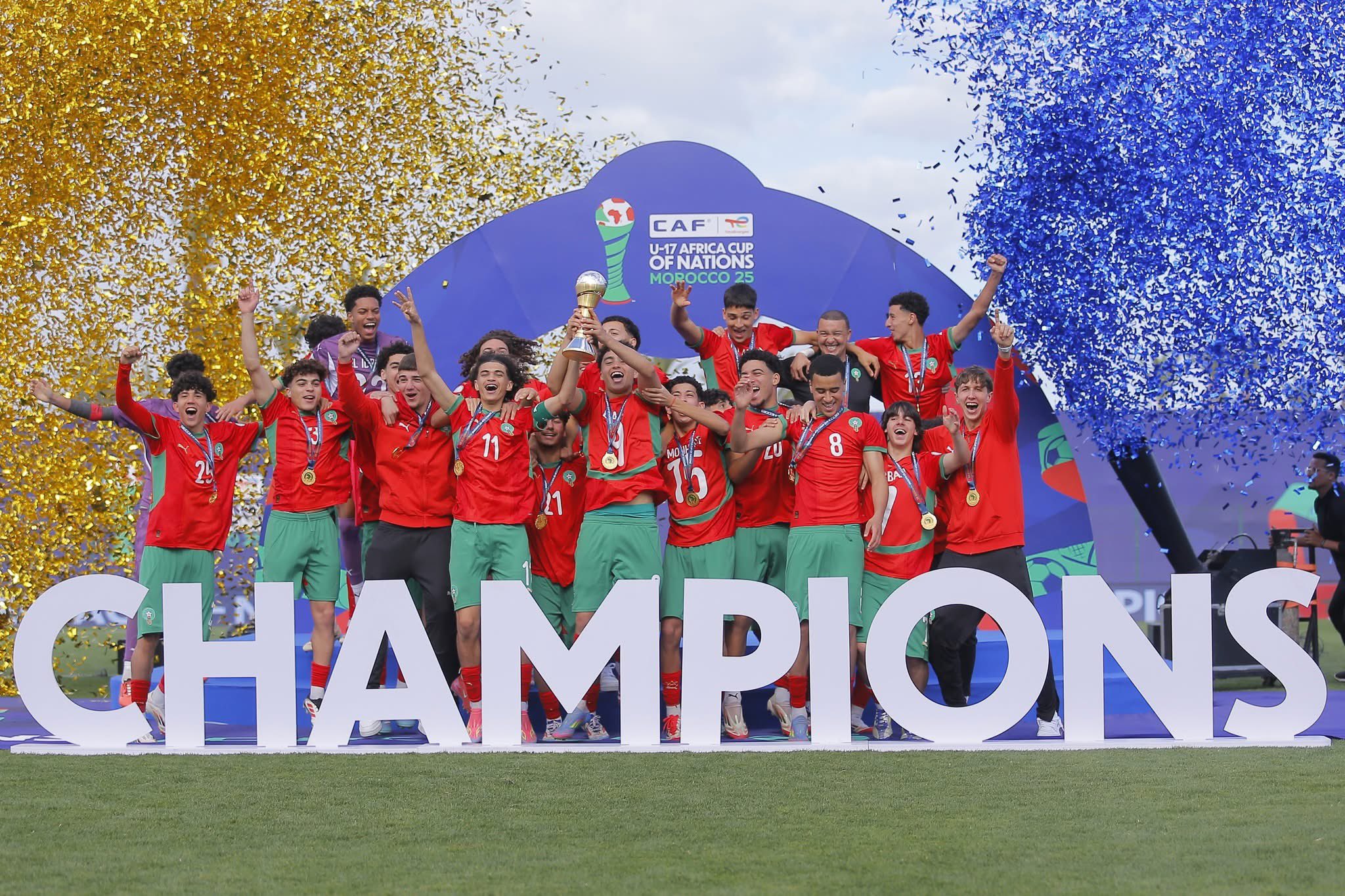

The final, a tightly contested affair, showcased the defensive resilience and tactical discipline of both sides. Morocco, led by head coach Nabil Baha, and Mali, champions in 2015 and 2017, battled relentlessly for 90 minutes, but neither could find the breakthrough. Despite several half-chances, including a disallowed Mali goal ruled out by VAR for a handball by Soumaila Fané, the scoreline remained goalless, leading to a nerve-wracking penalty shootout.


Morocco’s goalkeeper, Chouaib Bellaarouch, emerged as the hero of the night, making two crucial saves in the shootout to deny Mali’s Issa Koné and Lamine Keita. The Atlas Cubs displayed remarkable composure from the spot, with Ziyad Baha, Zakari El Khalfioui, Amine Ouahabi, and Ilies Belmokhtar converting their penalties with precision. The 4-2 shootout victory sent the home fans into raptures and secured Morocco’s maiden U-17 AFCON title.
“This is a proud moment for Moroccan football,” said coach Nabil Baha post-match. “The boys showed incredible heart and determination. Chouaib [Bellaarouch] was phenomenal, and the team’s unity carried us through.” Bellaarouch, who kept four clean sheets in five matches during the tournament, was named Man of the Match and later received the Golden Glove award. Midfielder Abdellah Ouazzane was honoured as the Best Player of the Tournament.
King Mohammed VI joined the celebrations, sending a heartfelt message of congratulations to the team. “It gives me great pleasure to extend my warmest congratulations on this well-earned African title,” the King wrote, praising the team’s achievement and Morocco’s hospitality as hosts.
The road to the final was no easy feat for Morocco. The hosts topped Group A undefeated, with victories over Uganda (3-0) and Tanzania (2-0), alongside a goalless draw against Zambia. In the knockout stages, they overcame South Africa and Côte d’Ivoire, both via penalty shootouts, showcasing their knack for thriving under pressure. Mali, meanwhile, reached the final with a confident 2-0 semi-final win over Burkina Faso, but their hopes of a third U-17 AFCON title were dashed in the shootout.
The victory ensures Morocco’s qualification for the 2025 FIFA U-17 World Cup in Qatar, alongside Mali, Burkina Faso, South Africa, Zambia, Côte d’Ivoire, Senegal, Tunisia, Egypt, and Uganda. For Morocco, the triumph ends years of near misses, having finished as runners-up in 2023 and fourth in 2013 when they last hosted the tournament.
Mali, despite the defeat, showed their quality throughout the tournament. Their attacking threats, Seydou Dembélé and Soumaila Fané, tested Morocco’s defence, but Bellaarouch’s heroics and Morocco’s clinical penalties proved decisive. Mali’s bid to surpass Nigeria, Ghana, Cameroon, and Gambia as the most successful team in U-17 AFCON history (all with two titles) fell short, but their performance underlined their status as a youth football powerhouse.
The 2025 U-17 AFCON, hosted in Morocco from 30 March to 19 April, was a landmark event, featuring an expanded 16-team format for the first time. The tournament showcased the continent’s brightest young talents, with Burkina Faso’s Ashraf Tapsoba earning the Golden Boot for his seven goals. Côte d’Ivoire secured third place, defeating Burkina Faso 4-1 on penalties after a 1-1 draw.
As the final whistle blew, the El Bachir Stadium erupted in joyous scenes, with players, coaches, and fans celebrating Morocco’s historic triumph. The Atlas Cubs’ victory not only marks a new chapter for Moroccan football but also sets the stage for an exciting future as they prepare to represent Africa on the global stage in Qatar.