


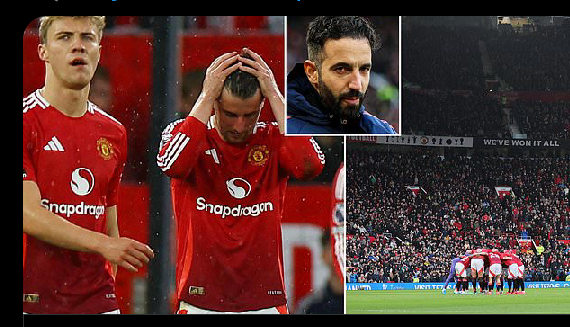
Manchester United Face £80m Financial Deficit After Extremely Poor Season.
Manchester United are grappling with a staggering £80 million financial shortfall following a calamitous 2024-25 season, marked by their failure to secure European football for the first time in a decade. The Red Devils’ struggles on the pitch have triggered a cascade of financial repercussions, including a hefty penalty from their kit sponsor, reduced Premier League earnings, and significant losses in matchday revenue.
A key blow comes from the club’s lucrative kit deal with Adidas. As part of their £90 million-per-year agreement, which begins in the 2025-26 season, United face a £10 million penalty for each season they fail to qualify for the UEFA Champions League. Having missed out on Europe’s elite competition for a second consecutive year after losing the Europa League final to Tottenham Hotspur, the clause has been activated, docking their sponsorship revenue.


The financial pain doesn’t end there. United’s poor Premier League performance, finishing well outside the top four, has led to a £20 million reduction in merit payments, which are distributed based on league position. This cut reflects the club’s slide to 16th place with just one game remaining, a far cry from their days of domestic dominance.
The absence of European football next season compounds the issue, with an estimated £30 million drop in revenue from UEFA prize money and broadcasting rights. Historically, European competitions have been a vital income stream, with United generating an average of £55.4 million per season from matchday and broadcast revenue over the past three years. Missing out entirely is a significant setback, particularly as the club also failed to qualify for the 2025 FIFA Club World Cup, which offers substantial prize money.
Matchday receipts are also expected to plummet by £20 million due to fewer home games. Without European fixtures, United will host only their standard 19 Premier League matches, potentially fewer if they exit domestic cups early. Despite efforts to boost matchday income—gate receipts per match rose from £5.0 million to £5.2 million this season despite less prestigious Europa League ties—the lack of additional fixtures will hit hard.
The financial strain comes at a challenging time for United, who reported a £113.2 million net loss last season, marking their fifth consecutive year in the red. The club’s struggles to comply with the Premier League’s Profitability and Sustainability Rules (PSR) add further pressure, with co-owner Sir Jim Ratcliffe overseeing cost-cutting measures, including job reductions and ticket price hikes, which have sparked fan discontent.
Manager Ruben Amorim, who has acknowledged the club’s precarious position, faces a daunting task. “We have to acknowledge our position,” he said after a recent defeat. “Sometimes I talk about relegation. Because our club needs a shock.” Despite the grim outlook, United are planning a squad overhaul, with potential signings like Wolves’ Matheus Cunha and Ipswich’s Liam Delap under consideration, though financial constraints may limit their ambition.
Football finance expert Kieran Maguire highlighted the scale of the crisis, noting that a successful Champions League campaign could be worth over £100 million when combining prize money, gate receipts, and sponsor bonuses. United’s co-owner Ratcliffe echoed this, estimating Champions League qualification at £80-100 million in value, compared to £40 million for the Europa League. The gap left by missing both is a stark reminder of the high stakes in modern football.
As United prepare for a season without European football, the club must navigate a delicate balance between financial recovery and squad investment. Fans, already frustrated by rising ticket prices and a lack of on-pitch success, will be hoping for a swift turnaround to restore the club’s fortunes both on and off the field.