


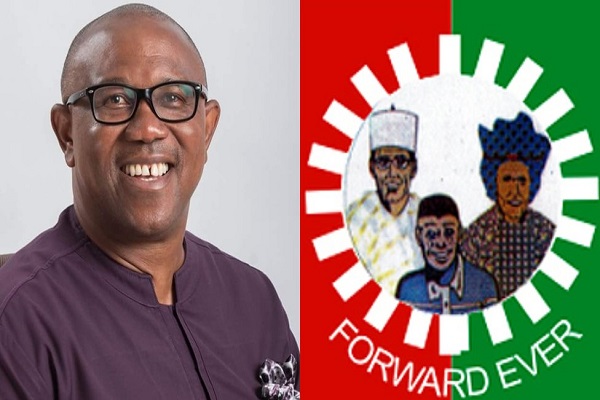
Labour Party Faction Led By Julius Abure Converge To Expel Peter Obi Over ADC Coalition Alignment.
A faction of the Labour Party (LP), led by Julius Abure, has announced plans to expel its 2023 presidential candidate, Peter Obi, for his involvement with a new opposition coalition backed by the African Democratic Congress (ADC). The decision, revealed by Abayomi Arabambi, the faction’s National Publicity Secretary, was made public during an interview on Channels Television’s *The Morning Brief* on Tuesday, 8 July 2025.
Arabambi accused Obi of engaging in anti-party activities by aligning with the ADC-led coalition, which includes prominent figures such as former Vice President Atiku Abubakar, former Senate President David Mark, and ex-governors Rotimi Amaechi and Rauf Aregbesola. The coalition, formally adopted as the ADC’s platform for the 2027 general elections, aims to challenge President Bola Tinubu’s All Progressives Congress (APC). Arabambi described Obi’s actions as “unconstitutional,” asserting that it is against party rules and Nigeria’s constitution to be affiliated with two political parties simultaneously. “We are convening a National Executive Council meeting where Obi will be expelled,” he stated, adding that the decision would be ratified at the party’s national convention.


The Labour Party’s move follows a 48-hour ultimatum issued to Obi on 3 July 2025, demanding his resignation from the party for his coalition involvement. Arabambi, representing the Abure-led faction, claimed Obi was already under suspension prior to his alignment with the ADC, further justifying the planned expulsion. He dismissed Obi’s contributions to the party’s prominence, arguing that the LP’s platform, bolstered by public discontent during the #EndSARS protests and past government failures, elevated Obi, not the other way around. “Obi did not make the Labour Party; the Labour Party made Peter Obi,” Arabambi declared.
Obi, however, has maintained that he remains a member of the LP while supporting the ADC coalition as a broader movement to address Nigeria’s governance challenges. In a recent interview, he clarified, “I am not a member of the ADC, but rather a supporter of the movement.” He defended the coalition as a necessary collaboration to foster inclusive leadership and rescue Nigeria from poor governance, reaffirming his intention to contest the presidency in 2027.
The LP’s internal crisis has deepened the divide between its factions, with the Abure-led group facing opposition from another faction led by Nenadi Usman, which has endorsed Obi’s coalition involvement. The Usman faction described the Abure group as “political jesters” lacking legitimate standing, citing a Supreme Court ruling that reportedly set aside a Court of Appeal decision recognising Abure as LP chairman. Meanwhile, the Enugu State chapter of the LP has openly backed Obi’s alignment with the ADC, announcing plans to promote the coalition’s agenda across its 160 wards.
Critics of the coalition, including Daniel Bwala, special adviser to President Tinubu, have dismissed its viability, predicting its collapse within six months due to internal struggles over leadership roles. Arabambi echoed this sentiment, labelling the coalition a “Yahoo Yahoo” alliance driven by opportunistic politicians. Despite these criticisms, Obi’s supporters argue that his coalition efforts reflect a commitment to national unity and progressive change.
As the Labour Party prepares to convene its NEC meeting, the planned expulsion of Obi marks a significant escalation in the party’s ongoing leadership tussle. The outcome of this internal conflict could reshape Nigeria’s political landscape ahead of the 2027 elections, with Obi’s next steps likely to influence the opposition’s strategy against the ruling APC.