

James Harrison, ‘Man With The Golden Arm’, Dies At 88 After Saving Millions Of Babies.
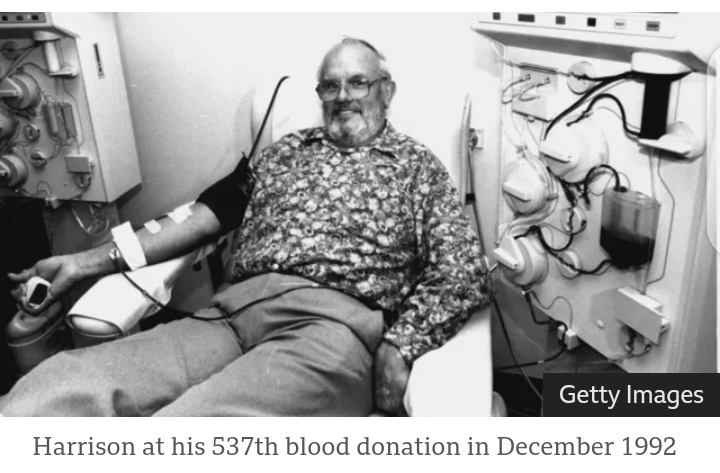
James Harrison, one of the world’s most prolific blood donors whose plasma helped save over two million babies, has died at the age of 88. His family confirmed that he passed away in his sleep at a nursing home in New South Wales, Australia, on 17 February.


Known as the “Man with the Golden Arm,” Harrison possessed a rare antibody, Anti-D, in his blood. This antibody is used to create life-saving medication for pregnant women at risk of their immune system attacking their unborn babies. His decades of selfless donations played a crucial role in preventing a deadly condition known as haemolytic disease of the foetus and newborn (HDFN).


A Lifelong Commitment to Saving Lives
Harrison’s journey as a blood donor began after he underwent major chest surgery at the age of 14 and required transfusions. Grateful for the help he received, he pledged to give back by becoming a blood donor.
At 18, he began donating his plasma every two weeks, a commitment he maintained until he was 81 years old. In 2005, he held the world record for the most blood plasma donated, a title he retained until 2022, when he was surpassed by a US donor.
The Australian Red Cross Blood Service, also known as Lifeblood, paid tribute to Harrison, highlighting his immense contribution to maternal and neonatal healthcare.
His daughter, Tracey Mellowship, expressed her father’s pride in his life-saving donations.

“He always said it does not hurt, and the life you save could be your own,” she recalled.
A Rare Gift That Transformed Medicine
Harrison’s ability to produce Anti-D antibodies remains a medical mystery, though some experts speculate it could be linked to the large blood transfusions he received at 14. His contributions were instrumental in the development of Anti-D injections in the 1960s, which have since prevented countless newborn deaths.
Before this breakthrough, one in two babies diagnosed with HDFN did not survive. The condition arises when a pregnant mother’s blood is incompatible with her baby’s, leading her immune system to attack the child’s red blood cells. This can cause severe anaemia, heart failure, or even death.
Despite there being fewer than 200 Anti-D donors in Australia, their plasma helps approximately 45,000 mothers and babies every year.
The Future of Anti-D Therapy
To address the shortage of Anti-D donors, Australian researchers at the Walter and Eliza Hall Institute of Medical Research, in collaboration with Lifeblood, are working to grow Anti-D antibodies in the lab.
Dr David Irving, Lifeblood’s research director, described the project as a “holy grail” noting the difficulty in finding regular donors capable of producing high-quality and sufficient antibodies.
James Harrison’s remarkable generosity has left a lasting legacy, not only in the lives he saved but in the future of medical science and maternal healthcare.