


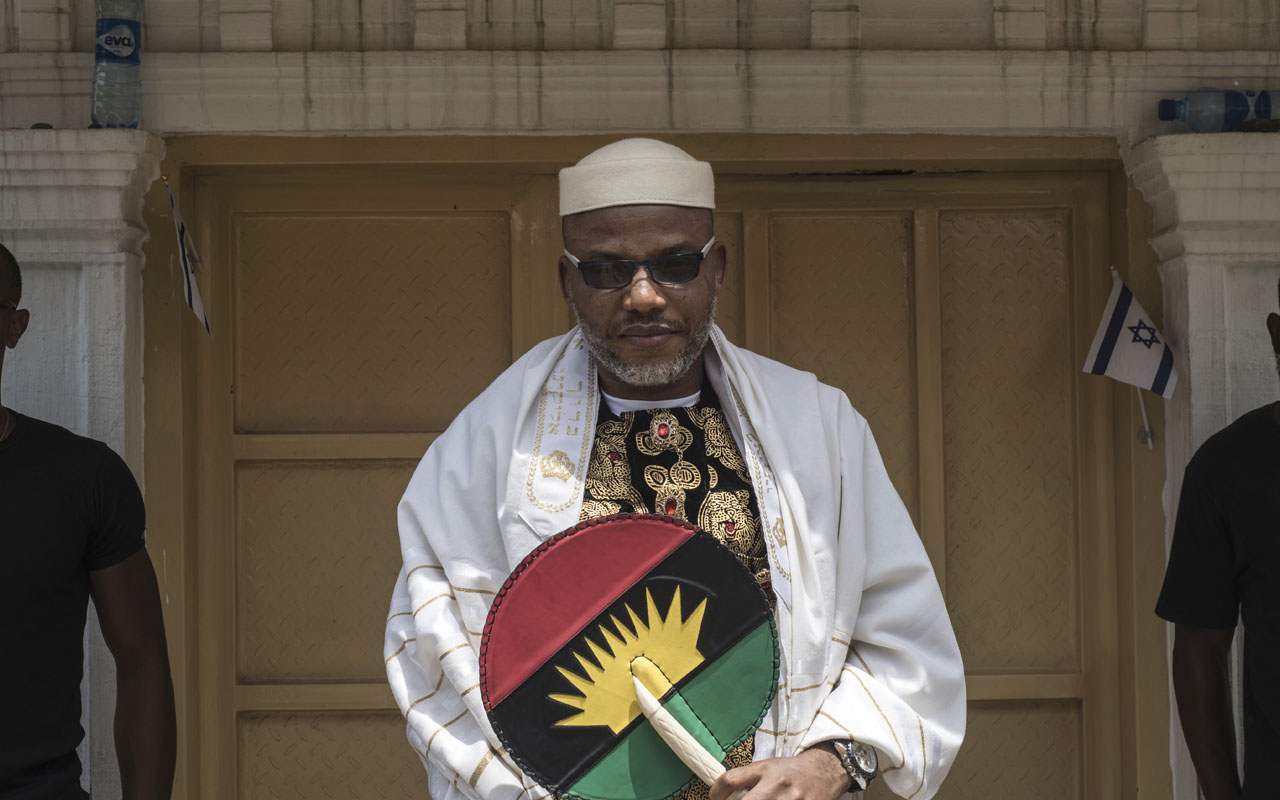
Federal Government Pushes For Nnamdi Kanu’s Trial, Citing Incendiary Broadcasts.
The Federal Government of Nigeria has intensified its legal pursuit of Nnamdi Kanu, the detained leader of the proscribed Indigenous People of Biafra (IPOB), insisting that he must face trial on terrorism charges. During a hearing at the Federal High Court in Abuja on Friday, 18 July 2025, the prosecution accused Kanu of making “deadly broadcasts” that incited violence and threatened national security, rejecting his no-case submission and urging the court to compel him to defend himself.

Kanu, who has been in the custody of the Department of State Services (DSS) since his re-arrest in Kenya in June 2021, faces a seven-count charge of terrorism and treasonable felony. The prosecution, led by Chief Adegboyega Awomolo, SAN, presented evidence including Radio Biafra broadcasts and videos, alleging that Kanu openly declared his intent to destabilise Nigeria and establish a Republic of Biafra. Awomolo argued that Kanu’s statements, which included calls to attack security personnel and their families, led to the deaths of over 170 security operatives and caused widespread fear among Nigerians. “The defendant boasted of killing security men and destroying Nigeria. This is not mere rhetoric but a deliberate threat to national security,” Awomolo told Justice James Omotosho, urging the court to dismiss Kanu’s application and order him to enter his defence.
In one broadcast played in court, Kanu allegedly declared a “total lockdown” in the South-East on 31 May 2021, instructing residents to stay indoors in memory of fallen Biafrans. Another video from the 2020 #EndSARS protests purportedly showed him directing attacks on police and government property. The prosecution further claimed that Kanu’s formation of the Eastern Security Network (ESN), described as IPOB’s armed wing, was aimed at advancing a separatist agenda through violence, citing attacks on 164 police stations and 19 INEC facilities.
Kanu’s defence, led by Chief Kanu Agabi, SAN, robustly contested the charges, arguing that the prosecution failed to provide evidence of incitement. Agabi described Kanu’s statements as “mere boasting” rather than criminal acts, asserting that his calls for self-defence were a constitutional right echoed by prominent Nigerians, including retired General T.Y. Danjuma. “No witness testified that they were incited to violence by Kanu’s broadcasts,” Agabi stated, criticising the prosecution’s reliance on DSS witnesses who admitted their role was limited to taking statements. He also challenged the legality of IPOB’s proscription and highlighted Kanu’s prolonged solitary confinement, which he claimed violated international law by exceeding 15 days.
The defence further argued that the prosecution’s case was weakened by inconsistencies, noting that charges had been amended eight times and that key witnesses frequently claimed memory lapses during cross-examination. Agabi urged the court to discharge and acquit Kanu, asserting that no prima facie case had been established.
Kanu’s family has accused the government of orchestrating a media campaign to discredit him, alleging that false narratives linking IPOB to South-East insecurity surface before his court dates to prejudice judicial proceedings. In a statement by Prince Emmanuel Kanu, the family condemned these efforts as a “systematic defamation” and demanded an independent probe into the region’s security challenges.
The case has sparked intense debate, with some Nigerians viewing Kanu’s broadcasts as a legitimate call for self-determination, while others see them as a dangerous incitement to violence. The Federal Government remains adamant, with Awomolo stressing that Kanu’s actions, including his alleged encouragement of attacks on public institutions, cannot be dismissed as mere bravado.
Justice Omotosho adjourned the matter to 10 October 2025 for a ruling on whether Kanu must enter his defence or if the no-case submission will be upheld. The outcome will likely have significant implications for Nigeria’s handling of separatist movements and the broader discourse on national unity and security.
