


Could The Catholic Church Be Ready For Its First Black Pope? Spotlight Turns To Cardinal Peter Turkson.
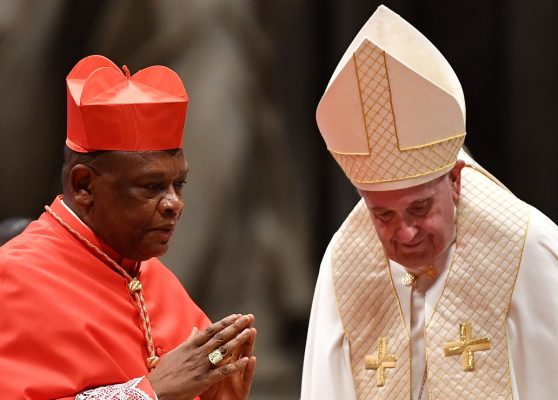
The Catholic world is abuzz with speculation following the death of Pope Francis, as attention shifts to who will be chosen to lead the Church into its next chapter. Among the prominent names being discussed is Ghanaian Cardinal Peter Turkson, a respected figure whose candidacy could make history as the Church’s first Black pope in over 1,500 years.
Cardinal Turkson, who made headlines in 2010 by declaring that both he and the Church were not ready for a Black pope, now finds himself at the heart of Vatican conversations. Back then, he had remarked that the first Black pope might face significant challenges. However, years later, he acknowledged that if it were God’s will, he would accept the responsibility.


Now 75, Turkson has long been a towering presence in the Church. Born into a modest Ghanaian family of ten, he became the country’s first cardinal in 2003 and has since played a major role both in Vatican administration and as a mediator in political tensions back home. His balanced approach, including moderate views on controversial issues such as LGBT rights, has earned him widespread respect.
He is not the only African being considered. Cardinals from Guinea and the Democratic Republic of Congo are also seen as possible successors to Pope Francis. Guinea’s Cardinal Robert Sarah, a well-known conservative, has attracted attention for his traditionalist views, while Cardinal Fridolin Ambongo of the DRC, a close advisor to Francis, is recognised for his leadership and commitment to maintaining doctrinal positions, especially concerning same-sex blessings.
The idea of an African pope is not without precedent. Pope Victor I, who led the Church from 189 to 199 AD, was of North African origin. But since then, the papacy has remained largely in European hands. Francis’s election in 2013, as the first Latin American pope, marked a historic shift, opening the door to broader representation in the Church’s leadership.
The proportion of African cardinals in the conclave has grown — from 8% at the last papal election to 12% today — reflecting the continent’s surging Catholic population. Africa is now home to 20% of the world’s 1.4 billion Catholics, a figure expected to rise significantly in the coming decades as Europe’s influence wanes.
Still, some clerics caution that racial discrimination, though often subtle, remains a barrier. A Congolese priest, speaking anonymously, noted that while progress has been made, lingering biases continue to shape perceptions within the Church.
Yet, for many across the continent, the dream of seeing an African ascend to the highest office in the Church remains alive. Father Paul Maji, a priest in Nigeria, expressed hope but added that sentiment should not outweigh divine purpose. “It has always been on our lips, how we wish to have an African pope,” he said. “But it’s not about our turn — it’s about God’s turn.”
An African pontiff could offer fresh perspectives on global issues, especially those disproportionately affecting the continent. Topics such as economic justice, environmental stewardship, and cultural traditions — including the Church’s approach to polygamous converts and celibacy among priests — would likely receive renewed attention.
While the conclave’s outcome remains uncertain, the growing prominence of African voices signals a broader transformation within the Catholic Church. Whether or not the next pope comes from Africa, the continent’s faithful can be assured that their voices are no longer at the margins, but at the heart of the global Church’s future.