


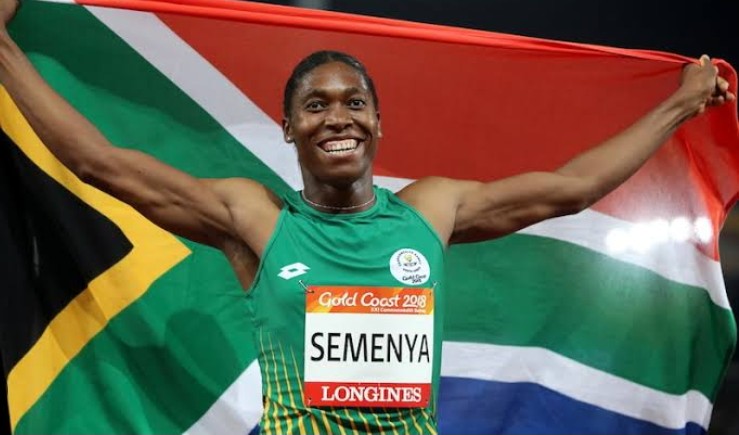
Caster Semenya Secures Landmark Victory In Human Rights Battle Against World Athletics.
South African athlete Caster Semenya has achieved a significant legal triumph at the European Court of Human Rights (ECHR), which ruled that World Athletics discriminated against her through regulations that barred her from competing unless she medically lowered her natural testosterone levels. The decision, handed down on 10 July 2025, marks a pivotal moment in Semenya’s ongoing fight for fairness and dignity in sport, though it does not immediately overturn the restrictions that have kept her from racing since 2019.


Semenya, a celebrated two-time Olympic gold medallist in the 800 metres (2012 and 2016) and three-time World Championship gold medallist (2009, 2011, and 2017), has been at the centre of a contentious debate over World Athletics’ rules targeting female athletes with differences in sexual development (DSD). Since 2018, these regulations have required DSD athletes to reduce their testosterone levels to below 2.5 nmol/L for at least six months to compete in events between 400 metres and a mile. Semenya, who was born with DSD and naturally produces higher testosterone levels, refused to comply, describing the requirement as a violation of her rights and dignity.
The ECHR’s Grand Chamber, in a 15-2 ruling, found that Switzerland’s Federal Court failed to provide Semenya with a fair hearing under Article 6 of the European Convention on Human Rights. The court criticised the Swiss judicial system for not conducting a “rigorous judicial review” proportionate to the impact on Semenya’s personal rights. However, her claims of discrimination, violation of privacy, and lack of effective remedy were deemed inadmissible, as they fell outside Switzerland’s jurisdiction. The ruling, which is final and cannot be appealed, awarded Semenya €80,000 (£69,000) to cover her legal expenses.
While the decision does not directly nullify World Athletics’ testosterone regulations, it paves the way for further legal challenges in Swiss courts, potentially reshaping how sports governing bodies approach eligibility rules. Semenya, now 34 and working as a coach, has vowed to continue her fight for other DSD athletes. “I have waited 15 long years for this judgment,” she said in a statement. “The fight will never be over. As long as we have injustice, we fight till the court.” She also called for greater protection of athletes’ rights, urging sports bodies to prioritise dignity and respect.
Semenya’s legal battle began after her breakout victory at the 2009 World Championships, where she faced invasive sex testing at the age of 18. Despite enduring years of public scrutiny and exclusion, including missing the Tokyo 2021 and Paris 2024 Olympics, she remains a symbol of resilience. Her earlier challenges at the Court of Arbitration for Sport (CAS) in 2019 and the Swiss Federal Court in 2020 were unsuccessful, but a 2023 ECHR ruling found she had been discriminated against by the CAS, setting the stage for this week’s landmark decision.
World Athletics has defended its regulations, arguing they are necessary to ensure fair competition in women’s events. The organisation has also introduced additional biological sex verification measures, such as cheek swab DNA tests, which have drawn criticism from human rights groups for marginalising DSD and transgender athletes. The debate over testosterone’s impact on performance remains contentious, with some studies suggesting it provides an advantage, while others argue the evidence is inconclusive.
This ruling has been hailed as a victory not only for Semenya but for athletes worldwide facing similar restrictions. Seema Patel, an associate professor in sports law at Nottingham Law School, described it as a “pivotal moment” for how sport engages with human rights. While Semenya’s return to competitive running remains uncertain, her determination to challenge discriminatory practices continues to inspire. “Athletes need to be protected,” she said. “Before we regulate, we must respect their rights first.”