


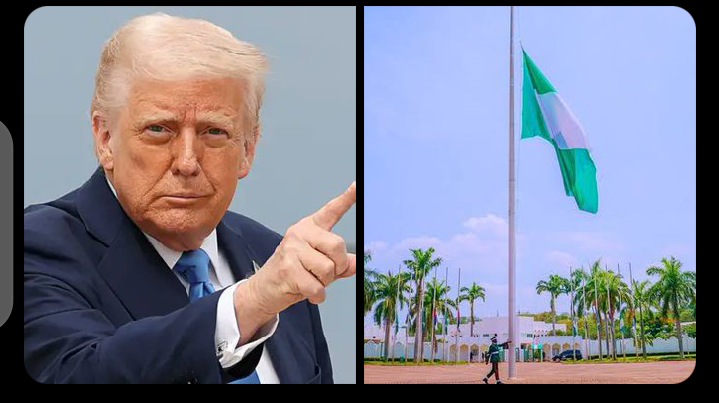
Trump Imposes Additional 10% Tariff On Nigeria Over BRICS Alignment.
US President Donald Trump has announced that Nigeria will face an additional 10% tariff on its exports to the United States, citing the country’s alignment with what he terms the “anti-American policies” of the BRICS economic bloc. The declaration, made via a post on Truth Social on Sunday, 6 July 2025, has sparked concerns about escalating trade tensions and their potential impact on Nigeria’s already strained economy.


The announcement comes as Nigeria, a partner country of the BRICS group since January 2025, attended the 17th BRICS Summit in Rio de Janeiro, Brazil, marking its first appearance at the forum. President Bola Tinubu, in a statement at the summit, reaffirmed Nigeria’s commitment to the Global South and called for financial restructuring and greater fairness in global governance, remarks that may have contributed to Trump’s perception of an “anti-American” stance. The BRICS bloc, comprising Brazil, Russia, India, China, South Africa, and newer members including Egypt, Ethiopia, Indonesia, Iran, and the United Arab Emirates, has been vocal about challenging Western-dominated economic systems, particularly the dominance of the US dollar.
Trump’s statement did not specify which BRICS policies he considers “anti-American,” but analysts suggest it may relate to the group’s push for reduced reliance on the US dollar and reforms to global financial institutions like the International Monetary Fund. “Any country aligning themselves with the anti-American policies of BRICS will be charged an additional 10% tariff. There will be no exceptions to this policy,” Trump wrote, signalling a hardline approach to nations engaging with the bloc. This new tariff adds to an existing 14% import tax on Nigerian goods, imposed by the Trump administration in April 2025, further straining Nigeria’s trade relations with the US.
The BRICS summit, which began on Sunday, saw leaders issue a joint statement criticising unilateral tariff measures as “inconsistent with World Trade Organisation rules” and warning of their disruptive impact on global trade. The group, representing over half the world’s population and 40% of global economic output, has positioned itself as a counterweight to Western influence, a stance that appears to have provoked Trump’s latest move. Nigeria’s participation as a partner country, alongside nations like Belarus, Thailand, and Uzbekistan, underscores its growing engagement with the bloc, though it has yet to secure full membership.
For Nigeria, the additional tariff could exacerbate economic challenges, with the country already grappling with inflation, a weakening naira, and reliance on crude oil exports for 90% of its foreign exchange. The Manufacturers Association of Nigeria has previously warned that US tariffs could disrupt supply chains and increase costs for consumers. However, some, like Nigerian billionaire Aliko Dangote, have suggested that the tariffs could encourage non-oil exports by forcing Nigeria to diversify its economy and meet global standards.
Nigeria’s Trade Minister, Jumoke Oduwole, has indicated that the government will seek a resolution through the World Trade Organisation, avoiding retaliatory measures to protect the benefits of the African Growth and Opportunity Act (AGOA), which grants duty-free access to the US market for eligible African nations. A subcommittee established in April 2025 is already assessing the broader impact of US tariffs on Nigeria’s economy, with fears of inflationary pressures and potential declines in oil prices looming large.
The move has drawn mixed reactions on social media in Nigeria, with some expressing frustration at the economic implications, while others have questioned the rationale behind labelling BRICS policies as “anti-American.” One post on X described the tariff as “the most funny thing ever,” noting Nigeria’s status as a consuming nation rather than a major exporter of manufactured goods.
As the 9 July deadline for Trump’s broader tariff negotiations approaches, with new rates set to take effect on 1 August, the US has secured trade deals with only the UK and Vietnam. The lack of progress in negotiations with other partners, including BRICS nations, suggests further economic friction ahead. For Nigeria, the additional tariff underscores the delicate balance between pursuing global partnerships and maintaining stable trade relations with the world’s largest economy.