


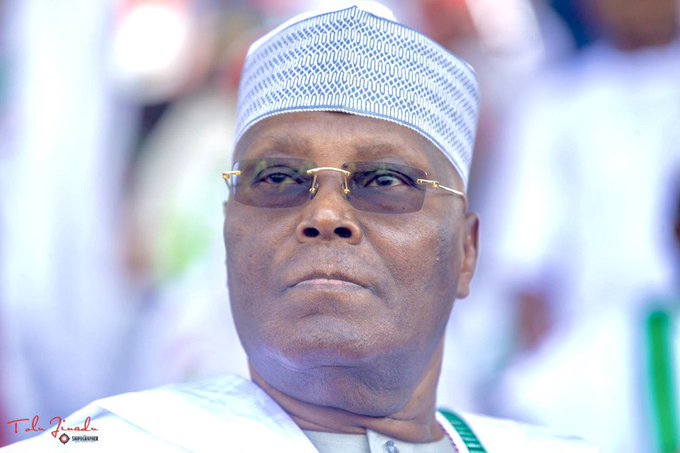
Atiku Abubakar Resigns From PDP, Citing Departure From Party Ideals.
Former Vice President of Nigeria, Atiku Abubakar, has resigned from the People’s Democratic Party (PDP), marking a significant shift in the country’s political landscape. In a letter dated 14 July 2025 and made public on Wednesday, Atiku announced his decision to step away from the PDP, citing a divergence from the party’s founding principles as the primary reason for his departure.
In his resignation letter, Atiku expressed regret over the move, stating, “I am writing to formally resign my membership from the People’s Democratic Party (PDP) with immediate effect.” He highlighted “irreconcilable differences” that have emerged within the party, which he believes no longer aligns with its original values. Atiku, a prominent figure in Nigerian politics and a former presidential candidate, extended his best wishes to the PDP and its leadership, expressing gratitude for the support he received during his tenure.


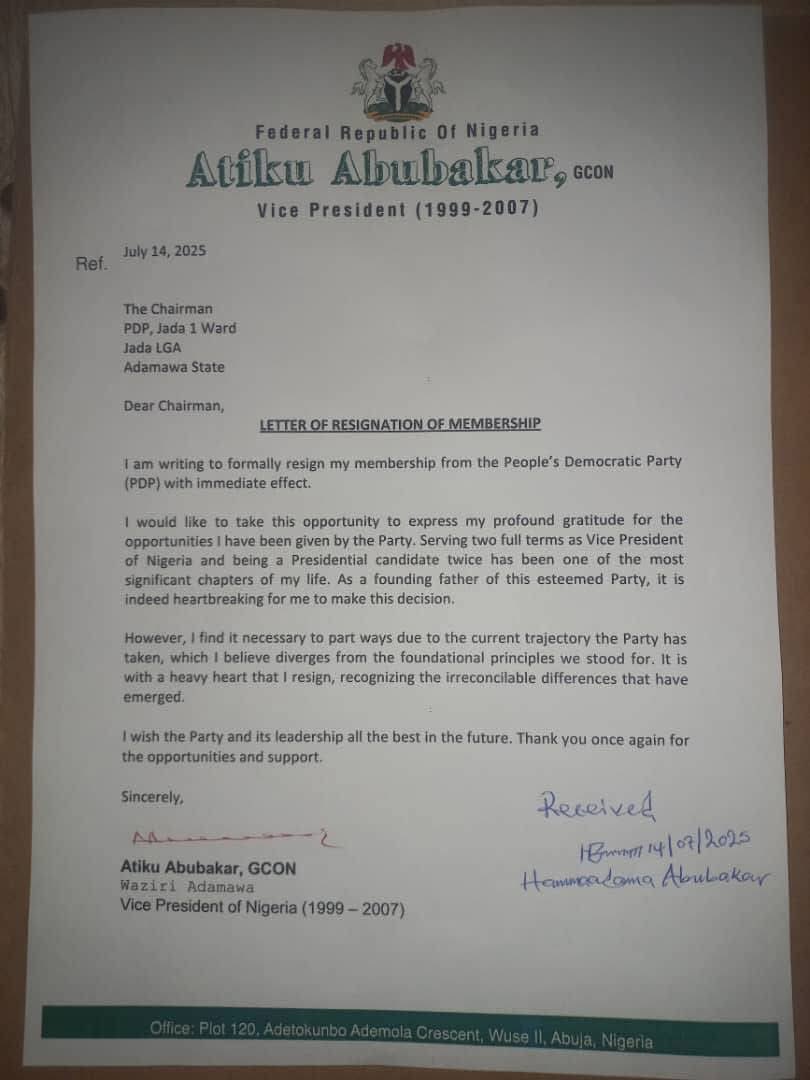

The resignation has sent shockwaves through the PDP, particularly in Atiku’s home state of Adamawa, where all local government and ward chairmen of Jada Local Government Area have also withdrawn their membership from the party in solidarity. This mass exit underscores the depth of discontent within certain factions of the PDP.
Speculation has been rife about Atiku’s next move, with reports suggesting he is poised to join the African Democratic Congress (ADC). This follows his involvement in a coalition of opposition figures, including former Senate President David Mark and other ex-governors, who have adopted the ADC as a platform to challenge the ruling All Progressives Congress (APC) in the 2027 general elections. Political analysts suggest this move could reshape the opposition landscape, with Atiku potentially eyeing another presidential run, possibly alongside figures like Peter Obi, who has also aligned with the ADC.
The PDP, already grappling with internal crises, faces further challenges with Atiku’s exit. Critics within the party, including former legal adviser Jacob Mark, have previously accused Atiku of destabilising the PDP by pursuing presidential ambitions across multiple parties. Others, such as former Deputy National Chairman Olabode George, have urged Atiku and other defectors to reconsider, arguing that the PDP remains a formidable force capable of uniting opposition efforts.
Atiku’s decision comes amid broader political realignments in Nigeria, with the ADC gaining traction as a coalition platform for disaffected politicians from both the PDP and APC. The coalition, launched in Abuja in March 2025, includes high-profile figures such as former Rivers State Governor Rotimi Amaechi and former Kaduna State Governor Nasir El-Rufai. Political observers note that the ADC’s growing prominence could pose a significant challenge to President Bola Tinubu’s administration in the lead-up to 2027.
As Nigeria’s political scene continues to evolve, Atiku’s resignation marks a pivotal moment for the PDP and the broader opposition. Whether this move will galvanise a unified front against the APC or further fragment the opposition remains to be seen. For now, Atiku’s departure signals a new chapter in his storied political career, with the ADC emerging as a potential vehicle for his ambitions.