


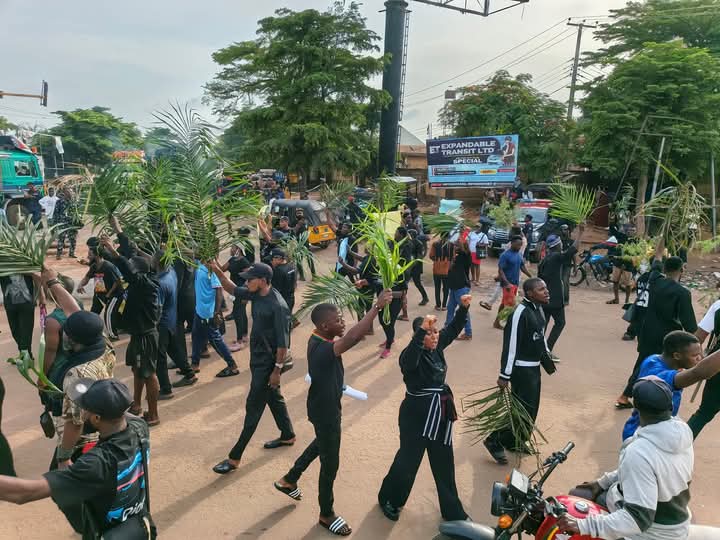
Benue Youths Block Abuja-Makurdi Highway In Protest Over Escalating Killings.
On Sunday, 15 June 2025, hundreds of youths in Benue State took to the streets, blocking the vital Abuja-Makurdi highway to protest the relentless wave of killings plaguing their communities. The demonstration, which began at approximately 7 a.m., saw impassioned protesters dressed in black, wielding palm fronds, placards, and banners, demanding an end to the violence that has claimed numerous lives in recent weeks.
The protest was sparked by a devastating attack on Saturday night in Yelewata and Saidu communities, where suspected armed herdsmen reportedly killed over 100 people, according to local sources. One protester, Mzamber Agatha, shared her heart-wrenching story with The Nation Newspaper, revealing that she lost her mother and five children in the massacre. “Stop Benue killings!” she pleaded, urging the federal government to take decisive action to restore security in the state.


The demonstrators gathered at the main gate of Moses Orshio University (formerly Benue State University) along the Makurdi-Gboko Road, bringing vehicular movement on the busy highway to a standstill. Posts on X captured the intensity of the protest, with images showing youths at Wurukum roundabout, a key junction in Makurdi, chanting and displaying signs condemning the violence. One post described the action as a response to the “latest killings at Yelewata that resulted in over 200 deaths,” though this figure remains unverified by official sources.
The violence in Benue State, particularly in areas like Guma, Gwer West, and Ukum, has been attributed to a complex mix of factors, including clashes between farmers and herders, unresolved boundary disputes, and activities of armed militia groups. According to Daily Trust, at least 270 people have been killed in the state between April and June 2025. The recent attack in Yelewata, which some reports claim claimed up to 200 lives, has intensified calls for urgent government intervention.
The Benue State Police have made efforts to address the crisis, with Commissioner Ifeanyi Emenari announcing the arrest of 42 bandits and suspected herders in connection with the killings. However, local communities and civil society groups, such as the Benue Democratic Ambassadors, argue that these measures are insufficient, describing the attacks as “targeted” and calling for a federal investigation.
In response to the escalating insecurity, the Chief of Army Staff, Lieutenant General Olufemi Oluyede, recently relocated to Makurdi to oversee operations aimed at curbing the violence. Additional troops and logistics have been deployed to the state, with Oluyede personally commanding operations to address the crisis. Despite these efforts, the protesters expressed frustration over the government’s perceived inaction, with many accusing authorities of failing to protect vulnerable communities.
Governor Hyacinth Alia, who has previously described the attacks as a “heinous act” and a reminder of the “pervasive violence and lawlessness” in the region, faces mounting pressure to address the crisis. The state government had issued warnings against unlawful gatherings, but the scale of public outrage appears to have overwhelmed such directives.
The blockade of the Abuja-Makurdi highway, a critical route connecting Benue to the federal capital, underscores the depth of frustration among residents. The protest has disrupted travel and commerce, with commuters stranded for hours. While the demonstration remained largely peaceful, it highlights the urgent need for a lasting solution to the security challenges in Benue State.
As the federal and state governments grapple with the crisis, the voices of Benue’s youths resonate with a clear message: the killings must stop, and the safety of their communities must be prioritised. The nation now watches to see whether these protests will spur meaningful action to restore peace to the troubled region.